How to Make a Wedding Guest List (Without Family Drama)
By Iris Calloway · August 11, 2026
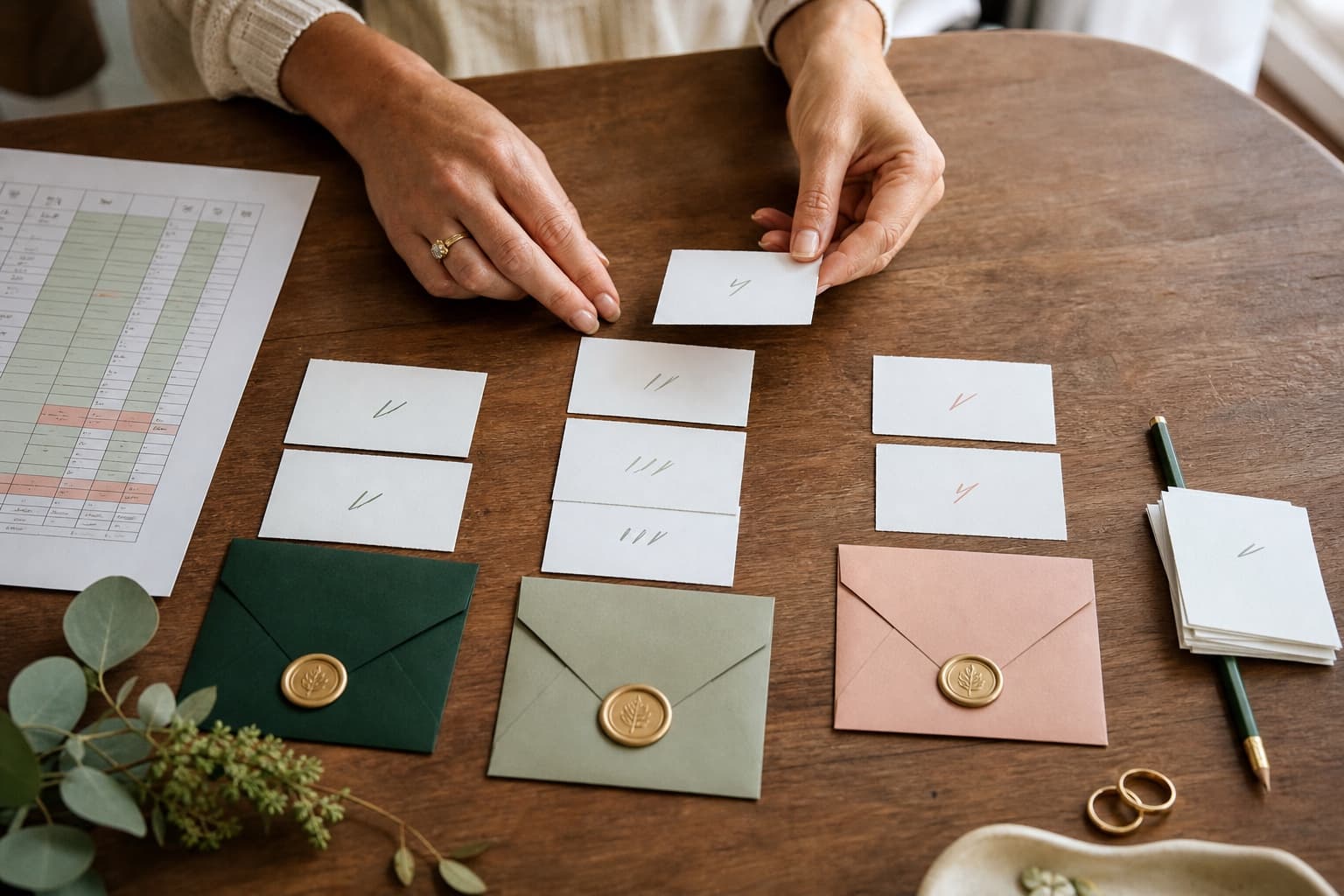
The hardest part of how to make a wedding guest list is not remembering names. It is deciding what the number is allowed to be before the names arrive.
Start with people and you will produce a list that feels emotionally correct and is financially impossible. Start with a ceiling, a small set of rules and one shared sheet, and most of the awkward decisions make themselves.
Not painless. Just legible.
How to make a wedding guest list from the number down
Your guest ceiling is the lowest of three numbers:
- the number your venue can hold in the layout you actually want
- the number your budget can feed
- the number of people you would still get to speak to for more than thirty seconds
The second one needs arithmetic. Pull every cost that changes with headcount into one line:
food + bar + per-person hire + stationery + favours + cake
---------------------------------------------------------- = cost per guest
                         guests
On our numbers that came to about $96 a person. A guest ceiling of 100 instead of 120 was therefore not a vague attempt to have a smaller wedding. It protected roughly $1,920.
Use your own quote, not mine. The wedding budget breakdown shows where to find every per-head line. If you do not have quotes yet, use a deliberately high estimate and replace it as the real numbers arrive.

Count seats and invitation units separately
A guest list has two totals, and confusing them creates most spreadsheet errors.
- Seats are people. A couple with two children uses four.
- Invitation units are households or individual invitations. That family usually uses one.
You need the seat count for the venue, caterer and budget. You need the invitation-unit count for stationery and postage.
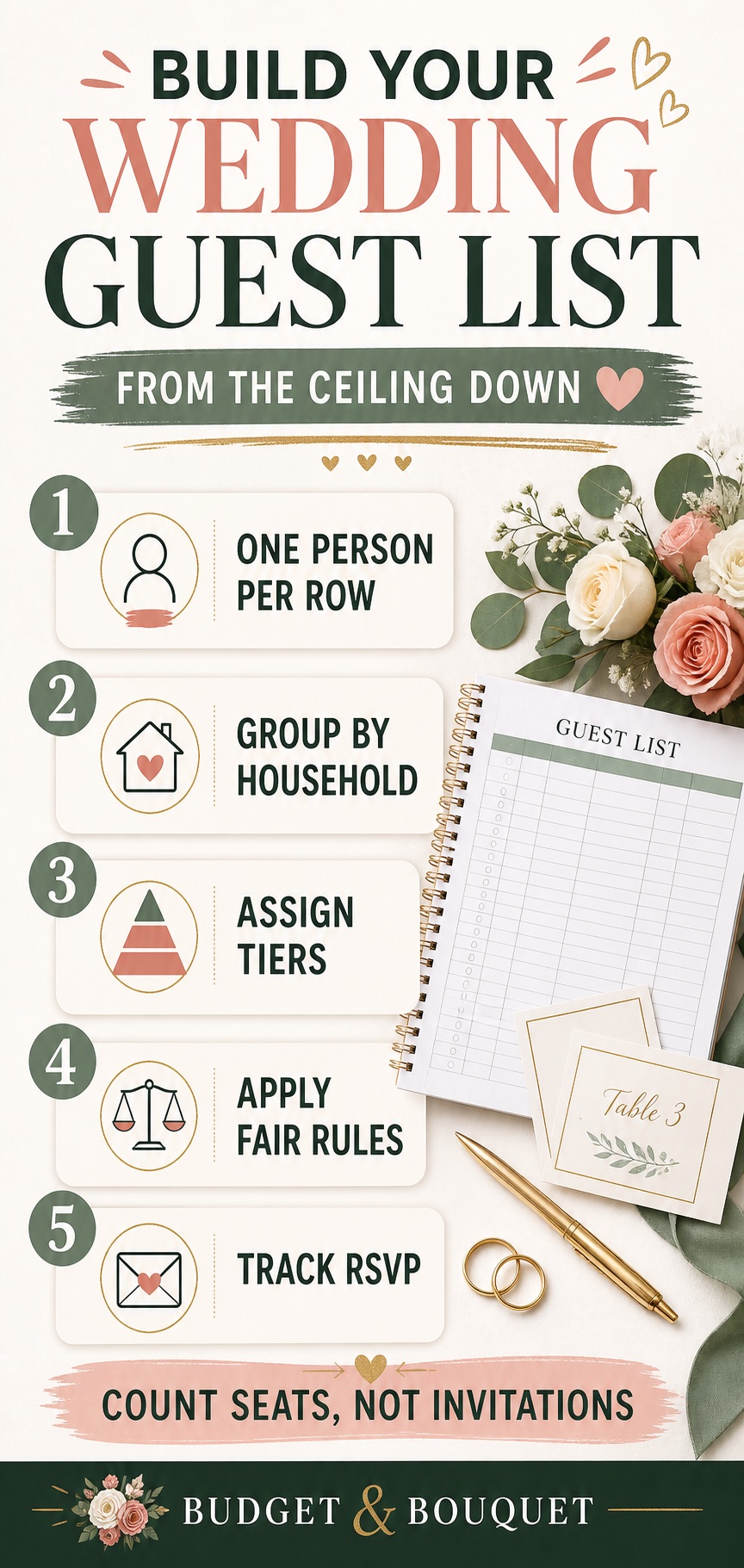
Put one person on each row, even when four people share an envelope. Give the household a shared ID such as H014. It feels fussy for about ten minutes and becomes useful the moment one person accepts, one declines and one needs a children's meal.
The minimum useful columns are:
| Column | What goes in it |
|---|---|
| Full name | One person per row |
| Household ID | Everyone receiving the same invitation |
| Side | Yours, your partner's, shared, or parent request |
| Group | Immediate family, extended family, friend, work |
| Tier | 1, 2 or 3 |
| Named partner | Yes or no |
| Invited | Yes or no |
| RSVP | Pending, yes or no |
| Meal and dietary notes | Only after they accept |
| Address | Collected once, used for every mailing |
If you want those columns already set up, the free wedding spreadsheet includes a self-counting guest-list tab. A plain shared sheet works too. The important part is that there is one list, not a version in each family group chat.

Build three lists before you combine anything
You and your partner should each make a list separately. Give contributing parents the same exercise if they will have guest requests. Nobody discusses individual names yet.
Use three tiers:
Tier 1 — the day would feel incomplete without them. Immediate family, closest friends and the people who are part of your present life.
Tier 2 — you would be genuinely glad to spend time with them. Extended family and friends you see less often but still have a real relationship with.
Tier 3 — history, obligation or somebody else's request. Former colleagues, distant relatives and people whose invitation begins with “we probably should.”
Now combine the sheets and remove duplicates. Do not split the available seats fifty-fifty between two sides. One person may have a family of six and the other forty cousins. Equal quotas produce tidy arithmetic and a strange room.
Fill the ceiling with both Tier 1 lists first, then both Tier 2 lists. Tier 3 is where parent requests and genuine spare capacity meet. If Tier 1 alone is already over the ceiling, the problem is not etiquette. The budget, venue or shape of the wedding has to change.
Decide the rules before the difficult names
The useful rules are not “invite the people we like.” You already know that. They are rules for the edge cases where reasonable people could decide differently.
Write down your answer to each of these:
- Are children invited, no children invited, or only children in the immediate family or wedding party?
- Are coworkers invited as one whole social group, or only coworkers you also see outside work?
- Are parents given a fixed number of request seats?
- Who receives an open plus-one?
- How are distant relatives handled consistently on both sides?
A named partner is not the same thing as an open plus-one. Current etiquette guidance treats spouses, fiancés and live-in or committed partners as part of the social unit, so put the partner's name on the list and invitation. An open plus-one is a genuinely unnamed seat the guest may fill. Emily Post's guidance also recommends offering one to single members of the wedding party; beyond that, it is a choice rather than a requirement.
For children, any rule can work if it is clear and consistent. “No children except our nieces and nephews” is a rule. “No children except the ones whose parents ask twice” is how a rule turns into a grievance. Address the invitation to the people actually invited; do not assume the phrase “adults only” will repair an ambiguous envelope later.
Consistency will not make every person happy. It does let you explain the decision without explaining what you think of them.
Give parents a number, not control of individual cuts
If parents are contributing, discuss guest expectations before accepting the money. A contribution with twenty requested seats attached is not the same offer as one with none attached. Neither is inherently unreasonable, but it needs to be visible while the budget can still move.
Give each set of parents a number and ask for a ranked list within it. Ten seats means ten actual people, including partners, not ten family names that quietly become eighteen at invitation time.
If their list is longer, do not debate whether Cousin Peter deserves to come. Hand the ranking decision back:
We have ten seats set aside for your guests and this list has fourteen people on it. Could you put them in priority order and send us the ten you most want there?
That sentence protects the relationship because the constraint is a number. You are not asking a parent to defend the importance of one friend against another, and you are not volunteering to do it for them.
If extra seats can be added and someone offers to pay for them, run the whole arithmetic first. Twelve extra guests at $96 each is $1,152, but that only works if the venue still fits them and adding another table does not trigger extra hire, flowers or staffing. Money can solve a budget limit. It cannot solve a fire-code limit or make a crowded room pleasant.
How to cut a wedding guest list without making it personal
First, cut categories. Then cut names.
Removing all former coworkers is easier to explain and fairer to apply than choosing two from a group of eight. The same is true of distant relatives, parents' friends and open plus-ones. A whole, consistent rule leaves less room for somebody to reasonably conclude that the real rule was whether you liked them enough.
For the individual names left at the edge, ask these in order:
- Have we had a real conversation with this person in the last year?
- Would we arrange to have dinner with them if there were no wedding?
- Are they part of our current life, or only an important part of an earlier one?
- Will we be glad we used one of our limited seats on them when we see the final table plan?
The one-year question is a prompt, not a law. A close friend living abroad may fail it. A coworker you speak to daily may pass it without belonging at the wedding. The four answers together are what matter.
Do not use a second-wave invitation list unless you are comfortable with the person knowing they were on it. Traditional etiquette advice prefers sending the guest list at once, and the practical problem is worse than the formal one: people talk. If you do hold a small second group, keep it to people outside the same social circle and send nothing to them—not even a save-the-date—until a seat genuinely exists.
The scripts for the conversations nobody wants
Long explanations create openings for negotiation. Use one true constraint and stop.
When someone asks why a relative is not invited:
We had to keep the wedding to 96 people, so we made one rule for extended family on both sides. I know it is disappointing, but we cannot add to the list.
When a guest asks for a plus-one:
We cannot accommodate additional guests beyond the people named on the invitation. I hope you can still come.
When someone assumes their children are included:
We are only able to invite the people named on the invitation, so we do not have seats for the children. We completely understand if that changes whether you can attend.
When a parent sends one more name:
Your ten seats are all assigned. If this person needs to be included, tell us which name you would like to replace.
The last sentence is the system doing the uncomfortable work. Nobody is being asked to agree that the ceiling is emotionally satisfying. They are being asked to choose within a real constraint.
Lock the list in the right order
Before the venue is booked, the guest list is a range. After the contract, it becomes a ceiling. Before save-the-dates, it becomes names.
Use this sequence:
- Set the affordable range.
- Draft and tier every name.
- Agree the partner, children, coworker and parent-request rules.
- Choose a venue that holds the maximum, not the hoped-for attendance.
- Confirm the ceiling in the contract.
- Lock the names before sending anything with a date on it.
- Add addresses, invitation units and RSVP tracking only after the list is agreed.
That order matters because a save-the-date is effectively an invitation. It is not the place to test whether a relationship still feels close in six months.
Once the list is locked, take the exact maximum count to every venue and ask for an all-in quote. These 45 venue questions make the quotes comparable, and the 12-month planning checklist shows when the invitations, RSVPs and seating chart need to happen.

Written by
I planned my own wedding on a spreadsheet that grew to twenty-two tabs, and I build planning spreadsheets for a living. This site is that file, cleaned up, plus what I learned about which decisions actually move the number.