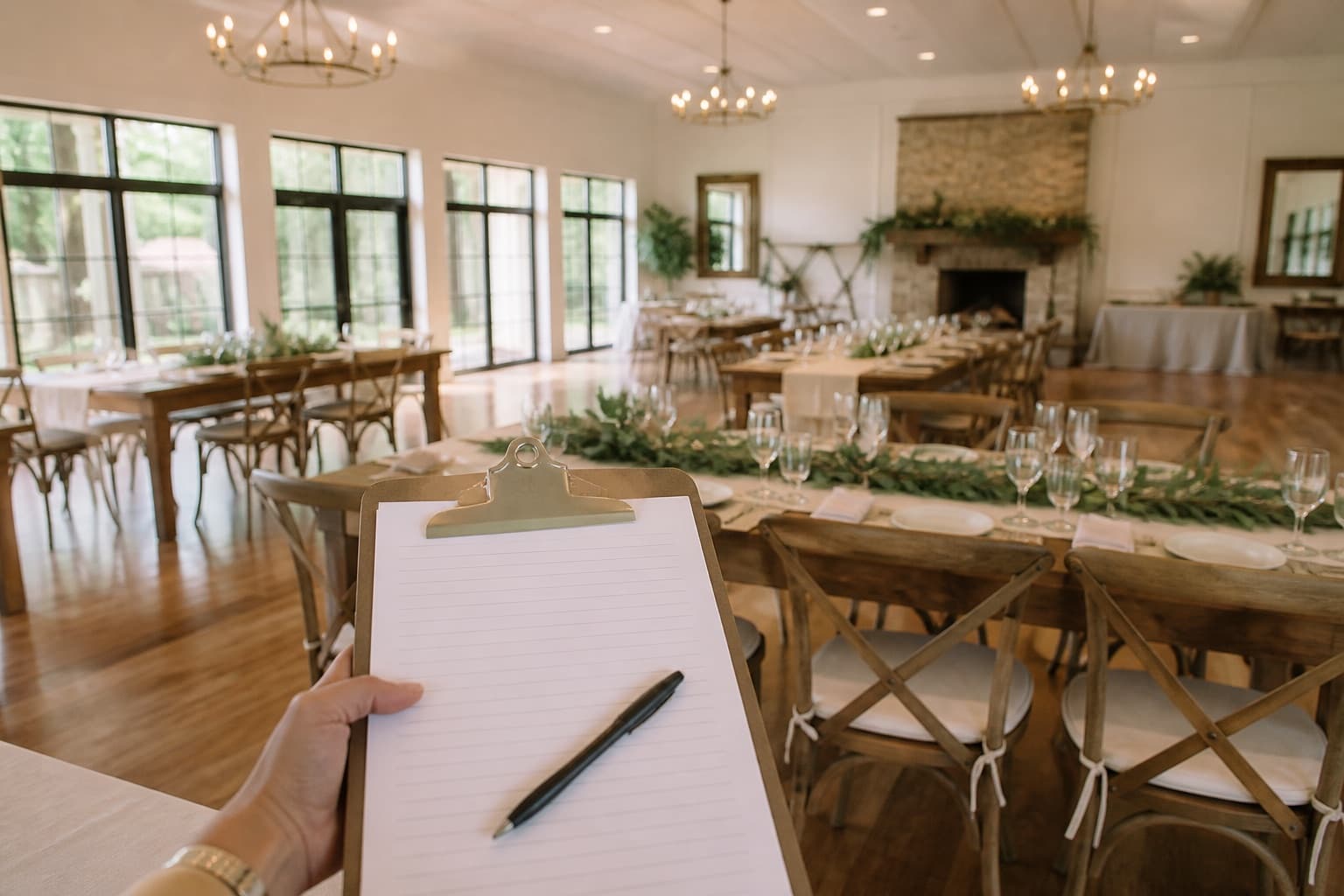
The Venue Comparison Spreadsheet Method
By Iris Calloway · August 12, 2026

Venue tours are designed to be memorable. Venue quotes are often designed in three different formats. Neither helps you compare the full cost of putting the same wedding into each building, which is the decision you are actually making.
The fix is a wedding venue comparison spreadsheet with two jobs. First, it converts every quote into the same all-in number at the same guest count. Second, it records practical constraints and scores them using priorities chosen before one room wins you over.

Build the sheet before the first tour
Create one workbook with five tabs: Requirements, Quote Comparison, Fit Score, Payments and Questions. You can add photographs or notes elsewhere, but these five tabs hold the evidence needed for a decision.
The Requirements tab defines the wedding being quoted. Record estimated attending guests, ceremony and reception structure, preferred date window, day-of-week flexibility, event hours, meal style, bar assumption, access needs and non-negotiable spaces. Give this same brief to every venue.
The Questions tab should begin with the full 45-question venue list. Add one column per venue and use Confirmed, No or Unknown where appropriate. “Probably included” is Unknown until the proposal or follow-up email confirms it.
Use the Quote Comparison tab only for costs. Mixing impressions and figures makes both harder to audit. The Fit Score tab handles qualities such as accessibility, travel and backup plans. The Payments tab handles timing, because an affordable total can still have an impossible deposit schedule.
The wedding planning spreadsheet can hold the final selected venue alongside the wider budget. Keep this comparison as the working paper: it should preserve rejected quotes and the assumptions behind your choice.
Set a standard pricing brief
Ask each venue to quote the same scope in writing. A useful request names enough detail to prevent a brochure minimum from becoming your comparison figure:
Please provide an itemised proposal for a ceremony and reception for 100 attending guests on an available Saturday in October 2027, with access from noon, guest arrival at 3:30pm and departure at 11pm. Please include the stated meal package, staffing, furniture, tableware, five-hour bar, service charge, tax and all required fees.
If you can consider several days, ask for each one separately. Do not average Friday and Saturday pricing. A date-specific quote should have its own column because minimum spend, access and overtime may all change.
Record the date the quote was issued, how long it is valid and the person who supplied it. Prices copied from a website are research, not a proposal. Mark them as estimates until the venue confirms your date and scope.
Use one currency and state whether tax is included. If a destination quote uses another currency, record both the original amount and a converted planning estimate with the exchange rate and date. The signed liability remains the original currency, so do not delete it after conversion.
Normalise every cost line
Venue A may call $8,000 a hire fee and price food separately. Venue B may quote $145 per person with the room included. Venue C may set a $17,000 food-and-beverage minimum. Put each component on its own standard row regardless of the venue’s terminology.
Start with these cost rows:
- room or site hire;
- ceremony fee;
- catering per person;
- bar per person, package or consumption estimate;
- food-and-beverage minimum;
- staffing and security;
- furniture, linens, tableware and glassware;
- service charge or administrative fee;
- sales or local tax;
- cake cutting and corkage;
- cleaning, rubbish or restoration;
- mandatory insurance or permits;
- overtime and early access;
- delivery or external-vendor fees;
- accommodation or room-block liability.
Use four supporting columns beside every value: Included, Required, Taxable and Source. A zero should mean confirmed $0, not “I did not find a price.” Leave an unknown amount blank and flag it. Otherwise a venue with the most missing information appears cheapest.
Service charge and gratuity are not interchangeable merely because both are percentages. Ask what each charge covers, whether gratuity is included and which subtotal the percentage applies to. Put the venue’s written answer in Source; do not infer payroll or tipping policy from the label.
Calculate the true all-in total
Create a Base Cost subtotal, Required Fees subtotal, Tax subtotal and Contingency line. The all-in comparison is:
base costs + required fees + tax + known external requirements + contingency = planning total
Worked example for 100 attending guests:
| Cost | Venue A | Venue B |
|---|---|---|
| Room and ceremony | $5,500 | included |
| Meal | 100 × $92 = $9,200 | 100 × $128 = $12,800 |
| Bar | 100 × $36 = $3,600 | included |
| Required hire | $1,250 | included |
| Staffing | $1,100 | included |
| Service charge | 22% × $12,800 = $2,816 | 24% × $12,800 = $3,072 |
| Tax estimate | $1,540 | $1,270 |
| Planning total | $25,006 | $17,142 |
Venue A’s $5,500 headline is lower, but the same event costs $7,864 more under these stated assumptions. The example is illustrative, not a market quote; substitute your proposals and use the exact taxable base each venue confirms.
Handle minimum spend carefully. If Venue C has a $15,000 food-and-beverage minimum and your selected package totals $13,600, budget $15,000, not $13,600 plus $15,000. The minimum is a floor. Record the $1,400 gap so you know whether upgrades can use money you already must spend.
Add a separate total per attending guest: planning total ÷ attending guests. This is useful for scenario testing, not for ignoring fixed costs. A $4,000 room fee stays $4,000 whether 80 or 100 attend, while meals scale with the count.
Run guest-count scenarios
Venue economics can reverse as the guest count changes. Test at least three scenarios: current expected attendance, a reasonable low case and the venue capacity or your approved high case. Do not use invited guests as if all will attend.
Suppose 120 people are invited and you currently expect 102 to attend. Use 90, 102 and 112 as planning scenarios if those are credible. For a $6,000 fixed hire plus $110 per attending guest:
- 90 guests: $6,000 + 90 × $110 = $15,900;
- 102 guests: $6,000 + 102 × $110 = $17,220;
- 112 guests: $6,000 + 112 × $110 = $18,320.
Now compare each result with minimum spend. A venue charging no hire but requiring $18,000 of food and drink costs $18,000 at both 90 and 102 if the package remains below the minimum. That venue becomes more efficient only as attendance uses the committed spend.
Check physical capacity in the layout you need. “Capacity 150” may mean a standing reception, 120 seated without a dance floor or 96 with the ceremony indoors. Record seated dinner, ceremony, wet-weather and accessible capacities as separate fields.
The guest-list method helps you set a ceiling before the venue expands it. A room holding 200 is not a reason to invite 40 more people; it is empty capacity unless those guests already belong inside your agreed budget and list.
Compare what the contract makes compulsory
A preferred-vendor list is not a note in the margins. It determines whether you can choose by price and style or must buy from a small market. Record every exclusive category: catering, bar, rentals, production, security, coordinator and insurance.
For each compulsory vendor, add the realistic cost to the venue comparison. If Venue A requires a rental company whose minimum order is $3,500, that requirement belongs in Venue A’s total even if the invoice will come from someone else.
Record restrictions with operational consequences:
- earliest setup and latest collection;
- music cutoff and sound limiter;
- candle, confetti and hanging rules;
- kitchen access for external caterers;
- delivery route and loading restrictions;
- required event manager or day-of coordinator;
- insurance limits and certificate deadlines;
- security ratios and minimum hours.
Then price the workaround. A 10pm music cutoff may require an earlier ceremony rather than money. A noon access time may require extra florist labour. A no-flame rule may change the centrepiece plan. A constraint is neither good nor bad until you know what it changes.
Read cancellation, postponement and minimum-count clauses before scoring value. A low deposit does not necessarily mean low exposure; later instalments may become non-refundable months before the event. Put every payment and cancellation threshold on the Payments tab.
Build a weighted fit score
Cost should be visible, but it should not be disguised as the only criterion. Choose fit criteria together and give them weights totalling 100 before you score venues. A workable starting structure is:
| Criterion | Weight |
|---|---|
| All-in cost and payment fit | 25 |
| Capacity and layout | 15 |
| Accessibility and guest comfort | 15 |
| Food and drink fit | 10 |
| Travel and accommodation | 10 |
| Weather backup | 10 |
| Access hours and logistics | 10 |
| Aesthetic fit | 5 |
| Total | 100 |
Score each criterion from 1 to 5 and multiply it by the weight. Divide by 5 to keep a 100-point total. If Venue A scores 4 on accessibility at weight 15, it earns 4 × 15 ÷ 5 = 12 points.
Define the scores before using them. For cost, 5 might mean at least 10% below ceiling, 3 within ceiling and 1 more than 10% above. For accessibility, 5 might mean step-free guest routes and accessible toilets without assistance, while 1 means essential areas cannot be reached.
Evidence belongs beside every score. “Beautiful” is not evidence for a 5. “No room reset, garden ceremony, windows on two sides” is. A score left Unknown should not silently become the neutral midpoint; resolve it or acknowledge that uncertainty in the decision.
Use pass/fail gates before weighted scoring. If a venue fails a genuine non-negotiable such as capacity, legal ceremony requirements or essential access, remove it. High marks elsewhere should not average away something that makes the wedding unworkable.
Record the wet-weather wedding

For every venue with outdoor space, compare two versions: intended layout and weather backup. Ask for a diagram or tour of the backup space when possible. “We move inside” is not enough to score capacity, comfort or room turnover.
Record who makes the weather call, at what time, using which forecast or condition, and what it costs. Some venues require a tent decision days ahead; some can move chairs on the morning; some sell an indoor room separately. Put that fee into the required-cost scenario if you would not proceed without it.
Test the complete guest journey in the backup plan. Where do arrivals wait? Is the drinks reception in the same room while dinner is reset? Does the accessible route remain covered? Where are family photographs taken? The wet-weather plan is the wedding you may buy, not an appendix to the one you prefer.
Give weather backup its own weighted score. Otherwise the garden earns the aesthetic points while the fallback remains unmeasured. A venue with a good second plan is often stronger than a spectacular first plan and nowhere credible to go.
Map deposits and payment exposure
On the Payments tab, use one row for every due date and one column per venue. Record amount, due date, refundability, payment method and the contract clause. Add cumulative exposure so you can see how much is at risk at any point.
Worked example: a $2,500 deposit is due at signing, $5,000 six months before and the $12,000 balance 30 days before. Cumulative committed cash becomes $2,500, then $7,500, then $19,500. Compare those dates with your actual contribution and saving schedule.
If your household can set aside $1,000 per month and the second instalment arrives in four months, you will add $4,000 before it is due. A current balance of $700 plus $4,000 equals $4,700, leaving a $300 shortfall. The total budget may work while that date does not.
Use the budget breakdown to test whether the venue consumes an appropriate share of your ceiling after required food, drink and hire are included. Do not compare a venue-only invoice with another package containing half the reception.
Keep deposits out of a separate “extra cost” line if they are instalments toward the total. Count them in cash flow, not twice in cost. Fees charged on top of a payment, such as card processing, should be separate if they are unavoidable.
Audit the shortlist after each tour
Update the sheet within 24 hours while details are fresh. Attach or link the proposal, floor plan, menu and follow-up emails. Give every new figure a source and every unresolved answer an owner and deadline.
Run an unknowns filter. A venue with 12 blank required-cost fields is not $3,000 cheaper; it has 12 unpriced risks. Send one consolidated follow-up instead of a chain of messages. Ask the venue to correct your summary if you have misunderstood anything.
Also record the person who would run the wedding day and whether you can meet them. The person selling the venue may not be the event manager. Communication fit matters, but score it from observed behaviour: response time, completeness and willingness to clarify terms, not whether the tour felt friendly.
After the second or third venue, review the weights rather than changing them to help a favourite. If you discover a genuinely missing requirement, add it for every venue and document why. If the new criterion applies only to one attractive feature, it is probably preference trying to become policy.
Choose from the evidence, then verify the document
Your leading venue should pass every gate, fit the cash-flow plan and score strongly on the priorities you set. The highest score is a recommendation, not an automatic instruction. If two venues are within a few points, compare the quality of evidence and the consequences of their weakest scores.
Before signing, replace estimates with the final proposal. Recalculate service charge and tax, confirm the guest-count assumption, and compare the contract with the quote line by line. Check the exact date, spaces, hours, inclusions, cancellation terms and wet-weather plan.
Save a final snapshot named with the decision date. Then move the selected planning total and payment schedule into the main budget, release other holds and keep the rejected comparisons. They explain the decision if a lower headline price later resurfaces without its exclusions.
A spreadsheet will not tell you whether a room feels right. It will tell you what that feeling costs, what it requires and which questions are still unanswered. That is enough structure for preference to make the final choice without being asked to do the arithmetic as well.

Written by
I planned my own wedding on a spreadsheet that grew to twenty-two tabs, and I build planning spreadsheets for a living. This site is that file, cleaned up, plus what I learned about which decisions actually move the number.