Wedding Budget Breakdown: Where Every Dollar Goes
By Iris Calloway · August 9, 2026
There are two ways to build a wedding budget. The first is to price everything you want and add it up, which produces a number you cannot afford and a fortnight of arguing. The second is to start from what you can spend, split it into categories, and then make each category earn its share.
This is the second method. It is less fun for about an hour and considerably less painful for the following year.
Start with the ceiling, not the wishlist
Your ceiling is one number: total money available, from every source, with a date attached to each part.
Write it as a list, not a total:
| Source | Amount | Available from |
|---|---|---|
| Us, already saved | $8,000 | now |
| Us, saving $650/month for 11 months | $7,150 | monthly |
| One set of parents | $6,000 | March |
| Ceiling | $21,150 |
The dates matter as much as the amounts. Roughly a third of wedding costs are deposits due in the first three months, and money arriving in March cannot pay a deposit in January. We had exactly this problem: the contribution that made our budget work landed four months after the venue wanted 25% down.
The split
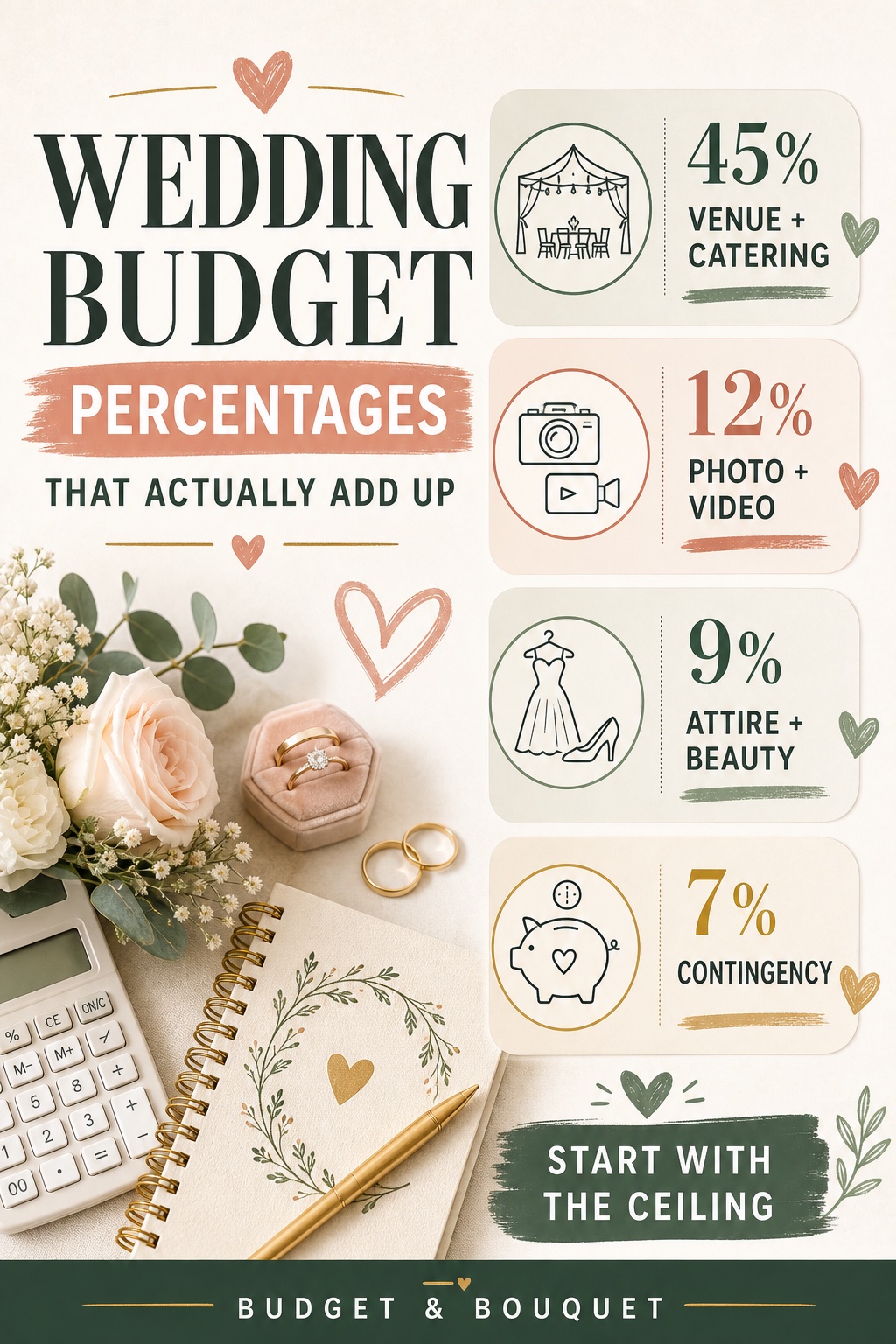
These are the shares I would start from. They are a starting allocation, not a law, and the section after this is entirely about when to break them.
| Category | Share | On a $21,400 budget |
|---|---|---|
| Venue and catering | 45% | $9,630 |
| Photography and video | 12% | $2,568 |
| Attire, hair and make-up | 9% | $1,926 |
| Flowers and decor | 8% | $1,712 |
| Music and entertainment | 7% | $1,498 |
| Stationery and signage | 3% | $642 |
| Cake and desserts | 2% | $428 |
| Rings | 3% | $642 |
| Transport | 2% | $428 |
| Gifts, favours, extras | 2% | $428 |
| Contingency | 7% | $1,498 |
Two things about that table.
Venue and catering is not one line, it is the line. At 45% it dwarfs everything else, and it is also the category most sensitive to guest count. Every decision in it multiplies.
The percentages are only useful once you have a ceiling. A 12% photography share is $2,568 at $21,400 and $960 at $8,000. The second number does not buy the same photographer, and pretending otherwise is how people end up disappointed by a vendor who delivered exactly what they were paid for.

Run your own numbers
The starting split from the table above, applied to your ceiling.
- Venue & catering45%$9,630
the line that scales with every guest
- Photography & video12%$2,568
flat cost — same price for 60 guests or 160
- Attire, hair & make-up9%$1,926
include alterations, not just the dress
- Flowers & decor8%$1,712
personal flowers plus the room
- Music & entertainment7%$1,498
ceremony and reception
- Stationery & signage3%$642
invitations, menus, place cards, postage
- Rings3%$642
both bands
- Cake & desserts2%$428
plus any cutting fee the venue charges
- Transport2%$428
you, the party, and anything hired
- Gifts, favours, extras2%$428
the small lines that add up
- Contingency7%$1,498
hold this back — it is not spending money
That venue & catering share works out to $100 per guest at 96 guests — the number to keep in view when the list grows.
A starting allocation, not a law — the post covers when to break it.
Why the guest count is the real budget
Most categories are fixed regardless of who comes. The photographer costs the same for 60 guests or 160. The dress costs the same. The rings, the officiant, the music — all flat.
But catering, bar, hire, stationery, favours, cake and often venue tier all scale per head. On our numbers that was roughly $84 a head before service charge, plus about $12 a head across stationery, favours and cake.
So each additional guest cost approximately $96.
That figure is more useful than any percentage in the table above, because it converts an emotional decision into an arithmetic one. Twelve more guests is not "a few more people." It is $1,152, which is most of a photographer upgrade or the entire flower budget on a smaller wedding.
Work out your own per-head number early:
per-head = (catering + bar + per-head hire + stationery + favours + cake) ÷ guests
Then, when the list creeps, you are not arguing about whether someone is close enough to invite. You are deciding whether they are worth $96 of a fixed pot. That is a much calmer conversation, and it stops the guest list being a referendum on relationships.
Build the guest list from that number before you start debating individual names. A ceiling and one set of rules do more to prevent family arguments than any perfect wording later.
What the big lines actually contain
Percentages hide the fact that each category is really a bundle of smaller decisions. These are the five biggest, unpacked — with the questions that change the quote.
Venue and catering (45%). This line usually bundles the room, food, staff, bar and basic hire, but which of those is included varies by venue, and that variation is the whole game. When we compared our three shortlisted venues on the headline price they were within $900 of each other. Once I put linens, corkage, staffing and the cake-cutting fee into the same spreadsheet column for each, the spread was $3,100. Ask every venue for one all-in figure at your guest count, then compare those. The headline number is not a price, it is an opening position.
Photography and video (12%). What moves this quote is hours of coverage, a second shooter, and what you receive at the end — files, an album, or both. Video roughly doubles the line, which is why it is the most commonly cut item on this list. If you are choosing between eight hours of a photographer you love and ten of one you like, take the eight. Coverage length is negotiable on the day in a way that talent is not.
Attire, hair and make-up (9%). The dress is the visible number; the invisible ones are alterations, shoes, underpinnings, and hair and make-up for anyone you are covering. Our alterations came to a fifth of the dress price, which I am told is normal and which nobody mentions at the point of sale. Whatever the dress costs, write a second line next to it for a quarter of that amount before you agree to anything.
Flowers and decor (8%). Two useful questions here. First, which pieces can do two jobs — ceremony arrangements that move to the reception tables earn their cost twice. Second, what is the labour share of the quote? Installations are mostly labour, table arrangements mostly stems. Our florist's quote dropped by a third when we cut one archway and kept every table exactly as it was.
Music and entertainment (7%). The structural fact from our own search: the live-band quotes came in at three to four times the DJ quotes we collected, for fewer hours. Neither is the wrong answer, but they are not the same line size, and the percentage above assumes the DJ end. If a band is one of your two priorities, take the difference from a category you named as negotiable, not from contingency.
Adjusting all of this for where you are
Every number on this page comes from one wedding in Madison, Wisconsin, in 2025. That is a mid-size midwestern city, which makes it a reasonable middle of the road, and completely wrong for you if you are marrying in Manhattan or in a rural county two hours from anywhere.
You do not need a national average to correct for that. You need your own multiplier, and it takes about an hour to find.
Get three real quotes for the same thing. Pick your largest line — catering, per head, at your guest count, all inclusive. Ask three local venues or caterers for that one number. Do not describe your budget first, because you will get a quote shaped around it rather than around the work.
Divide by the figure here. If the three come back at $110, $126 and $118, your local average is $118 against my $84. Your multiplier is about 1.4.
Apply it only to the lines that are local. This is the part people get wrong. Costs split into two groups, and they behave differently:
- Local and variable: venue, catering, bar, flowers, hire, transport, hair and make-up. These track your local market, so the multiplier applies.
- National or personal: rings, attire, stationery, photography above a certain level. A dress costs roughly the same in both places. Photographers travel. Applying a 1.4 multiplier to your ring budget just spends more money for no reason.
So on a 1.4 local market, the venue and catering share of a $21,400 budget does not become 45% of a bigger number — it becomes a larger share of the same number, which is the actual problem. That share might need to go to 52%, and the difference has to come out of somewhere you have named as negotiable.
Three levers that move the multiplier back down, in order of how much they save:
- Day of the week. Friday and Sunday quotes came in materially below Saturday at every venue we asked. If you are flexible here, ask for all three before you decide.
- Month. Peak season in most markets is a short window, and the quote either side of it is a different quote.
- Distance from the city. Forty minutes out changed our venue economics more than any negotiation did.
The point of the table earlier is not the percentages. It is that a budget has a shape, and the shape survives translation even when the numbers do not.
The categories that reliably blow up
Six lines account for almost every overrun I have seen, including my own.
Catering extras. The quoted per-head figure is rarely the paid per-head figure. Service charge, staffing, cake-cutting fees, corkage, linens and hire are the usual exclusions. Ask for a quote that includes everything and compare that number, not the headline.
Alterations. Frequently 15–25% of the cost of the dress, and almost never budgeted. If the dress is $1,400, put $250 next to it.
The bar. The most volatile line in the whole budget, because consumption is not predictable and the pricing models differ wildly. Open bar, consumption bar and limited bar can differ by thousands on the same guest count. Switching ours from open to beer, wine and one cocktail six weeks out is the single reason we finished under.
Because the bar is the most volatile line, it is worth doing the arithmetic properly rather than accepting a package. Three models, same 96 guests, same five hours:
| Model | How it prices | 96 guests, 5 hours |
|---|---|---|
| Open bar, per person | flat package per head for the event | 96 × $36 = $3,456 |
| Consumption | you pay for what is poured | ~2.5 drinks/head × 96 × $9 = $2,160 |
| Beer, wine, one cocktail | narrower list, per head | 96 × $14 = $1,344 |

The spread between the top and bottom row is $2,112 on an identical guest count and an identical five hours. Nobody at our wedding remarked on the absence of a full spirits list, and that single change is most of the reason we finished under.
Two things the table hides. Consumption billing is the least predictable, so if your ceiling is tight, the certainty of a flat per-head package can be worth paying a premium for. Ask what happens if consumption runs over the estimate, and get the answer in writing.
And every model has a corkage position. If you are allowed to supply your own wine, ask the per-bottle fee before assuming that is the cheap route: at $15 a bottle corkage, supplying your own stops saving money somewhere around the mid-range shelf. The venue that lets you bring everything in is usually charging for it elsewhere.
One more lever, which costs nothing: shorten the bar rather than narrowing it. Closing during the meal is normal, nobody notices, and on a per-hour model it removes a full hour of billing from the middle of the evening.
Postage. Invitations are heavy, and square envelopes cost more. On 118 invitations this is a real line, not a rounding error.
Vendor meals. Photographers, planners and bands usually need feeding, and it is usually in the contract. Ten vendor meals at your per-head rate is another $840 nobody planned for.
Overtime. The most expensive hour of your wedding is the one after the venue's cut-off. Know the rate before the day, and decide in advance whether you would pay it.
When to break the percentages
The table is a starting point. Here is when to ignore it.
When you have two clear priorities. Ours were food and photography. We went well over on both and took it out of flowers, favours, transport and video. Nobody noticed the missing pieces, and we have the photographs.
When the guest list is small. Under about fifty people the fixed costs dominate, so photography, attire and rings become a much larger share by arithmetic alone. Percentages designed for 120 guests will mislead you.
When the venue is all-inclusive. If it bundles catering, hire and staffing, its share may run to 55–60% and the rest of the table shrinks proportionally. That is not overspending, it is a different structure.
When something is being provided. A family member doing the flowers or a friend doing the music does not mean the line is zero. Budget for materials and a proper thank-you, and keep the line visible so the shape of the budget stays honest.
A worked rebalance
Say the ceiling is $21,400 and the first pass comes back at $24,900. Do not shave 15% off everything, which is how you end up with a slightly worse version of every single thing.
Cut in this order:
- Reduce the guest count. At $96 a head, twelve fewer guests recovers $1,152 and touches nothing else you care about.
- Change the bar model. Open to limited saved us close to $1,400 without a single person remarking on it.
- Move the date. A Friday or a Sunday, or a month out of peak season, frequently changes the venue quote by 10–20%. This one is free if you have not printed anything.
- Cut whole categories, not slices. No favours, no videographer, no formal cake cutting. Removing a category entirely is invisible. Making every category slightly cheaper is very visible.
- Only then, negotiate. And do it on scope, not price: fewer hours, fewer arrangements, a smaller package. Asking a vendor to do identical work for less is how you get worse work.
Run those four and you have found roughly $3,500 without downgrading anything you named as a priority.
What to do the week you start
- Write the ceiling as a list of sources with dates.
- Set your working ceiling below the real one.
- Calculate your per-head number and put it somewhere you will see it.
- Allocate by percentage as a first pass, then immediately adjust for your two priorities.
- Record estimated and contracted side by side from day one. The gap tells you how wrong the rest of your estimates are.
Ours ran about 12% over on estimates on average, so from month six I added 12% to every new estimate and stopped being surprised by quotes.
If you want this already built, the free spreadsheet has the budget tab with these categories loaded and the per-head arithmetic written, plus a guest list tab that counts itself. The 12-month checklist covers the order to spend it in, and 45 questions to ask a venue covers the single line that takes 45% of it.

Written by
I planned my own wedding on a spreadsheet that grew to twenty-two tabs, and I build planning spreadsheets for a living. This site is that file, cleaned up, plus what I learned about which decisions actually move the number.