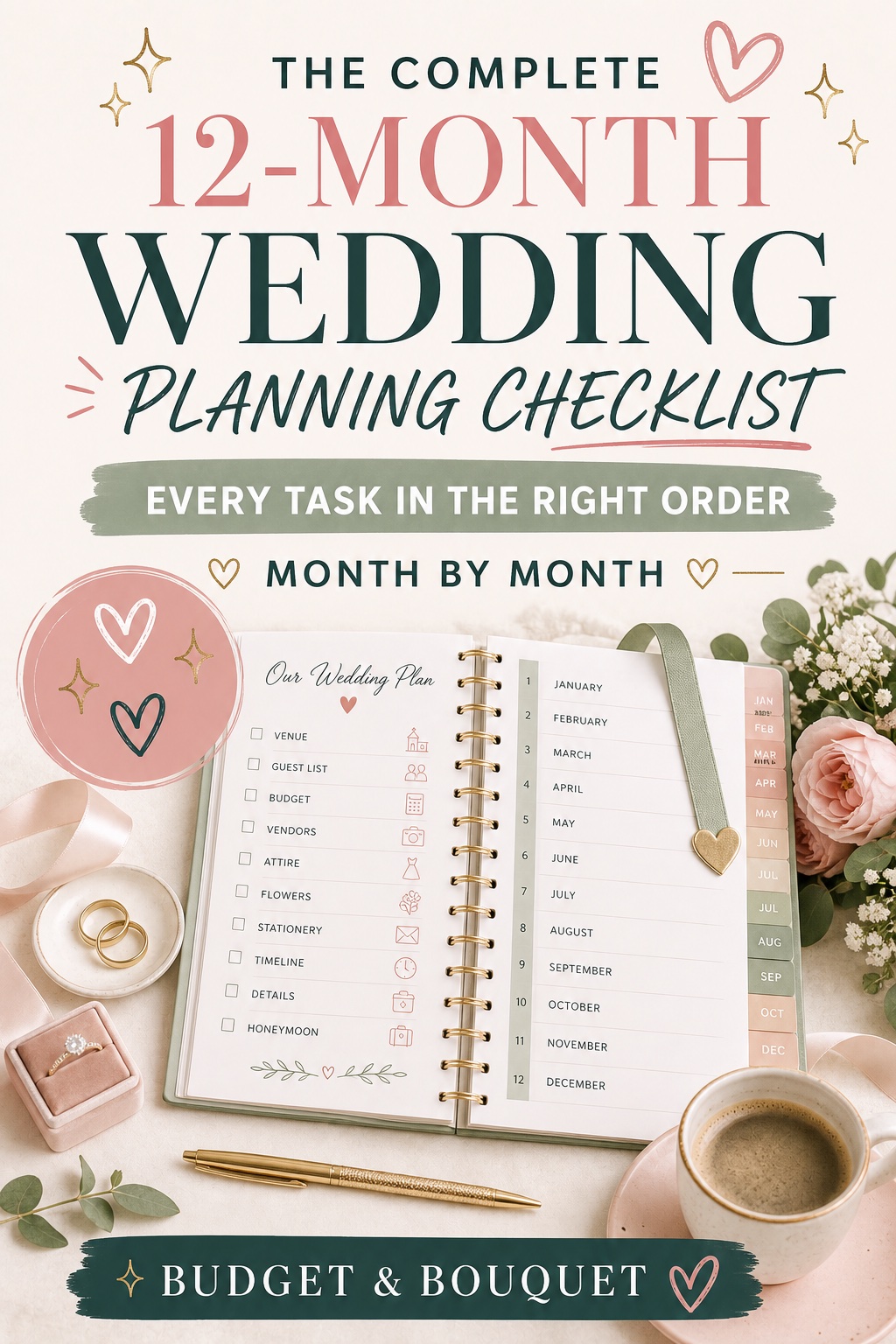
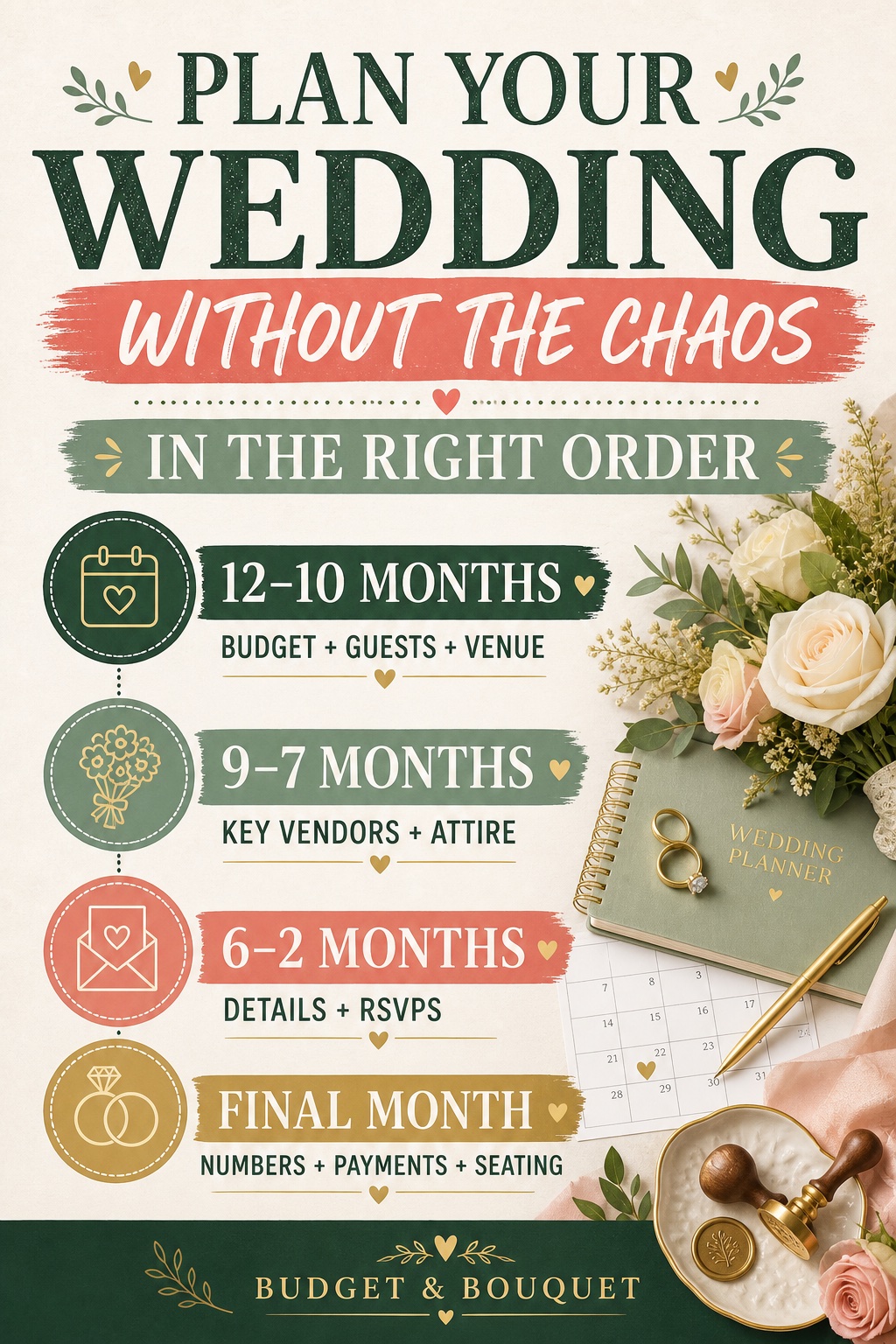
The Complete 12-Month Wedding Planning Checklist
By Iris Calloway · August 8, 2026
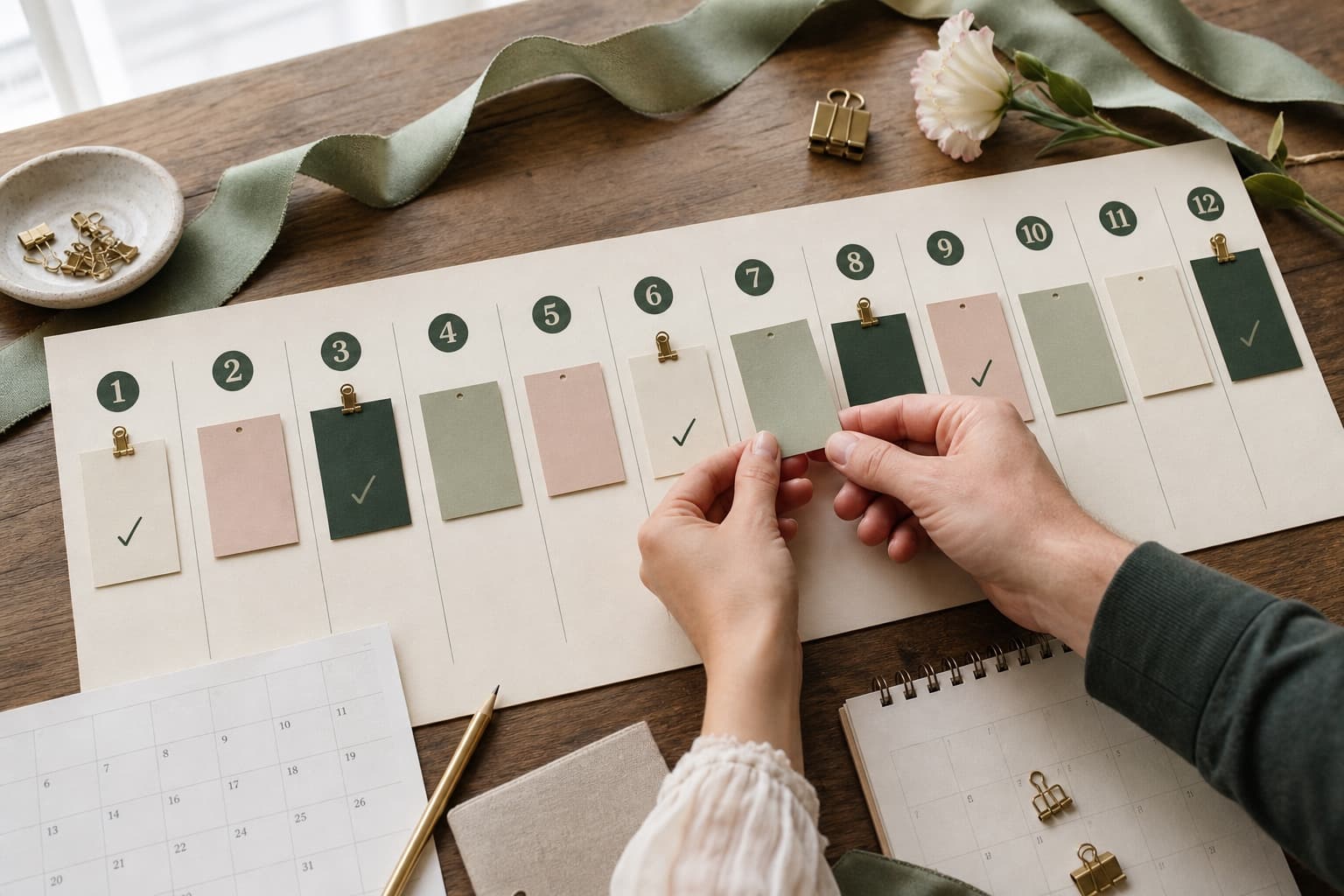
Most wedding checklists are written forwards, which is the wrong direction. They open with "choose a colour palette" and bury the guest count somewhere around month seven, by which point you have already signed a venue contract that assumed a number you had not decided.
This one runs on dependencies. Some decisions unlock other decisions. Some cost you money if you make them out of order. Everything below is arranged by what breaks if you leave it late, not by what feels exciting.
The three decisions everything else hangs on
Before any month-by-month detail, three choices constrain every later one. Until these are settled, most other planning is guesswork you will redo.
1. The budget ceiling. Not a hope — a number you have agreed out loud, with a named source for each contribution. "My parents are helping" is not a number. "My parents are giving us $6,000, and it lands in March" is.
2. The guest count. This is the single largest multiplier in the whole event. Catering, bar, venue size, hire, stationery, favours and cake all scale off it. A rough band is enough at this stage: 80, 120, 200. It just has to be honest.
3. The date and season. Which determines availability, price, and how much runway everything else gets.
Here is why the order matters. We invited 118 people and sat 96. If I had budgeted for 118 at the per-head rate we were quoted, I would have set aside roughly $2,600 more than we needed and made every other decision against a ceiling that was wrong. Twenty-two people is not an unusual gap. Plan for who attends, not who is invited, and keep the difference visible.

12 months out — the decisions
This is the only section where the order is strict.
- Agree the total budget and who is contributing what. Write down each contribution, who it comes from, and when it arrives. Money that appears in month nine cannot pay a month-two deposit.
- Draft the guest list. Not addresses, just names, so you have a count. Build it from a ceiling, then use two columns: definite, and maybe. The maybes are where the arguments live.
- Decide the shape of the day. Ceremony and reception in one place, or two? Meal served, or stations? These change the venue shortlist more than any aesthetic preference.
- Shortlist venues and tour them. Take the same list of questions to each one so you are comparing like with like. Our 45 venue questions exist because we did not do this on the first three tours and had to go back.
- Book the venue and lock the date. Only now is the date real.
Compare venues on one number, not three brochures
Venue quotes are built to be incomparable. One includes staffing and excludes linens, the next bundles the bar and charges separately for the ceremony room, a third quotes a room fee with catering priced per head on top.
The fix is a single column. For each venue, ask for one figure: everything included, at your guest count, on your date. Then put the three next to each other.
| Barn | Hotel | Restaurant | |
|---|---|---|---|
| Headline quote | $6,400 | $7,100 | $6,900 |
| Linens, glassware, hire | +$780 | included | included |
| Staffing / service | +$1,150 | included | +$620 |
| Ceremony room | +$500 | +$350 | — |
| Cake-cutting fee | +$220 | +$180 | — |
| After 10pm | +$400/hr | +$250/hr | not available |
| All-in, before extras | $9,050 | $7,630 | $7,520 |
On the headline numbers those three are within $700 and the barn looks cheapest. On the all-in numbers the barn is $1,500 more expensive than either alternative, and it is the only one that charges for the hours you are most likely to want.
We toured before building that column and nearly signed on the wrong figure. Build it after the first tour, not the last, so you know which questions you are still missing while you can still ask them.
Do not send save-the-dates before the venue contract is signed. We ordered ours the week we verbally agreed a venue and had to reprint when the date moved by a fortnight. It cost $180 and a small amount of dignity.
9 to 11 months — the one-a-day vendors
Some vendors take one booking per day. They are the constraint, so they go first.
- Photographer. Book before anything decorative.
- Caterer, if the venue does not provide it. Ask what the quoted per-head figure excludes — service charge, staffing, cake cutting, corkage and hire are the usual exclusions.
- Band or DJ.
- Officiant, and check the legal requirements for your county. This is the one item where a missed form is not recoverable with money.
- Start the outfit search. Not because it is urgent aesthetically, but because alterations have lead times and many dresses are made to order on a three-to-six month schedule.
A note on quotes at this stage: get them in writing and get them itemised. "From $2,000" is a marketing figure. Our florist's "from $2,000" turned out to be $3,400 for the arrangements we had actually pointed at in the meeting. That is not dishonesty, it is a starting price doing its job — but you cannot budget against it.
6 to 8 months — the list becomes real
- Firm up the guest list and collect addresses. A shared spreadsheet beats a group chat. This is the moment the count stops being a band and becomes a number.
- Order invitations once the count is stable.
- Book transport, if you need it.
- Block guest accommodation. Hotels usually release unbooked rooms back at a deadline, so read the release date before you sign.
- Order or start the cake.
- Plan the honeymoon, at least far enough to know what it costs and when you are paying for it.
4 to 5 months — the details that need lead time
- Choose and order stationery beyond the invitations — menus, place cards, table numbers, signage.
- Confirm the ceremony structure: readings, music, who is standing where.
- Buy or order wedding party outfits. If people are paying for their own, tell them the price range before you tell them the shop.
- Hair and make-up trials, if you are having them.
2 to 3 months — sending and scheduling
- Send invitations. Set the RSVP deadline four weeks before the caterer's deadline, not on it, because you will be chasing people.
- Build the day-of timeline. Start from the ceremony time and work outward in both directions. Every vendor needs an arrival time, and they need to be told the same one.
- Finalise the menu and confirm numbers with the caterer, provisionally.
- Write the vows, if you are writing your own.
- Confirm the legal paperwork is filed and correct.
1 month — the closing sequence
- Chase RSVPs. You will have to. We were still missing thirty-one replies four weeks out, and every one of them arrived by text after a direct message. Do not take it personally and do not wait politely.
- Give the caterer the final headcount. Note what date the number becomes non-refundable, because after that point a cancellation still costs you.
- Build the seating chart. Do it after the final count, never before.
- Confirm arrival times with every vendor in writing. A phone call is not a record.
- Pay outstanding balances, or diarise them.
- Delegate. Decide who is holding the timeline on the day, and it should not be either of you.
The week of
- Confirm final numbers to the venue.
- Hand the timeline to whoever is running the day.
- Pack whatever is going with you the night before.
- Stop making decisions. Anything unresolved by now is either fine or it is not going to be fixed by worrying about it at 1am.
After
- Return hires within their window. Late fees on hired items are the last preventable cost of the whole event.
- Pay final invoices and reconcile against your budget.
- Write thank-you notes while you still remember who gave what.
Six weeks after ours I opened the file one more time to reconcile the last vendor payments, and found it oddly satisfying to close out a project that had been open for fourteen months.
If your engagement is shorter than twelve months
Compress, but keep the order. The dependency chain does not change; only the gaps between the steps do.
Here is what six months actually looks like, because "compress it" is not instructions.

Weeks 1–2 — everything that constrains everything else. Budget ceiling agreed, guest list drafted, and venue tours booked for the same week rather than spread over a month. Take the venue questions to all of them, and ask each one directly what they have free in your window before you fall for the room. At six months you are choosing from what exists, so lead with availability.
Weeks 3–4 — sign, then book the one-a-day vendors. Venue contract signed. Then photographer, caterer, music and officiant in the same fortnight, because they are booking from the same shrinking pool of dates you are.
Week 5 — skip save-the-dates entirely. They exist to reserve a date months before the invitation. At six months there is no gap to fill, so send the invitation itself as early as your guest list allows. That single decision saves a printing round, the postage on it, and about three weeks.
Weeks 6–10 — the long-lead items, in parallel. Attire is now the binding constraint rather than the venue. Off-the-rack or a short-lead designer, and get the alterations appointment booked at the same time you buy. Order stationery. Confirm the ceremony structure.
Weeks 11–16 — invitations out, RSVP deadline tight. Set the deadline three weeks after sending rather than the usual four to six, and say plainly on the card that you are on a short timeline. People respond to a stated reason.
Weeks 17–22 — the standard closing sequence. Final numbers, seating, vendor arrival times in writing, balances. This part does not compress, because it depends on RSVPs that depend on invitations. Protect it.
Weeks 23–26 — the week-of list, unchanged.
Three months is the same sequence again, harder. You are choosing almost entirely on availability, which is a real trade-off rather than a failure, and a smaller guest list opens dramatically more dates. The two things that reliably break at three months are attire lead times and anything printed, so go off-the-rack and consider digital invitations without guilt.
What does not change at any length: nothing gets printed before the venue contract is signed, and the seating chart still waits for the final count.
What to track, and where
A checklist tells you when. It does not tell you whether you can afford the thing you are about to book, which is why most people end up running two documents and reconciling them badly.
Four things are worth tracking from month twelve, and all four change as you go:
Contracted versus estimated. Every line starts as an estimate and becomes a contract. Keep both numbers. The gap between what you guessed and what you signed is the single most useful figure in the whole file, because it tells you how wrong your remaining estimates probably are. Ours ran about 12% over on average, so from month six we simply added 12% to every new estimate and stopped being surprised.
Deposit paid versus balance due. A wedding is not one payment, it is roughly twenty, spread across a year, most of them landing in the final eight weeks. Knowing the total is not the same as knowing whether March is survivable.
Due dates. Every vendor has one, they are all different, and almost none of them will remind you.
Who is chasing what. If two of you are planning, the most common failure is not overspending. It is both of you assuming the other one confirmed the transport.
The month-eight problem
There is a predictable slump around month eight. The exciting decisions are made, the urgent ones are not due yet, and nothing appears to be happening. Two things go wrong in that gap.
The first is drift. Nobody chases the vendors who have gone quiet, and you discover in month five that the florist you thought was booked never returned the signed contract.
The second is scope creep, which is more expensive. With no deadlines to react to, it is a natural moment to start adding things: a welcome party, a second photographer, upgraded chairs. Each is defensible on its own. Together they are how a budget goes from workable to tight without a single obviously bad decision.
The fix is boring. Put a recurring thirty-minute check in the calendar for months seven to nine. Confirm anything unconfirmed, and note any new item against the budget before enquiring about it, not after you have fallen for it.
Questions to settle early that nobody puts on a checklist
These are not tasks, but they determine tasks, and leaving them vague causes rework:
- Who is actually deciding? If parents are contributing, does that come with input? Agree this before the money arrives, not after a disagreement about the guest list.
- What are the two or three things you genuinely care about? Ours were the photographer and the food. Knowing that made every later trade-off easy, because everything else was negotiable by definition.
- What are you both willing to skip? We had no favours, no videographer and no formal cake cutting. Nobody mentioned it, then or since.
- What happens if it rains? Every outdoor plan needs a wet-weather version that you would actually be happy with, decided while you are calm.
The three mistakes that cost the most
Budgeting for the invited number instead of the attending number. Covered above, and worth repeating because it is the most expensive one.
Signing before you have read what "all inclusive" excludes. Ours excluded linens, the cake-cutting fee, and anything after 10pm. None of that was hidden; we simply had not asked.
Ordering anything printed before the thing it refers to is contractually confirmed. Dates move. Printers do not refund.
Print the one-page checklist if you want it on the fridge. The next thing worth reading is where the money actually goes, because a checklist tells you when and a budget tells you whether. If you want the version that does the arithmetic for you, the free spreadsheet has a budget tab and a guest list tab with the formulas already written.

Written by
I planned my own wedding on a spreadsheet that grew to twenty-two tabs, and I build planning spreadsheets for a living. This site is that file, cleaned up, plus what I learned about which decisions actually move the number.