Save-the-Dates vs Invitations: The Complete Timeline
By Iris Calloway · August 12, 2026
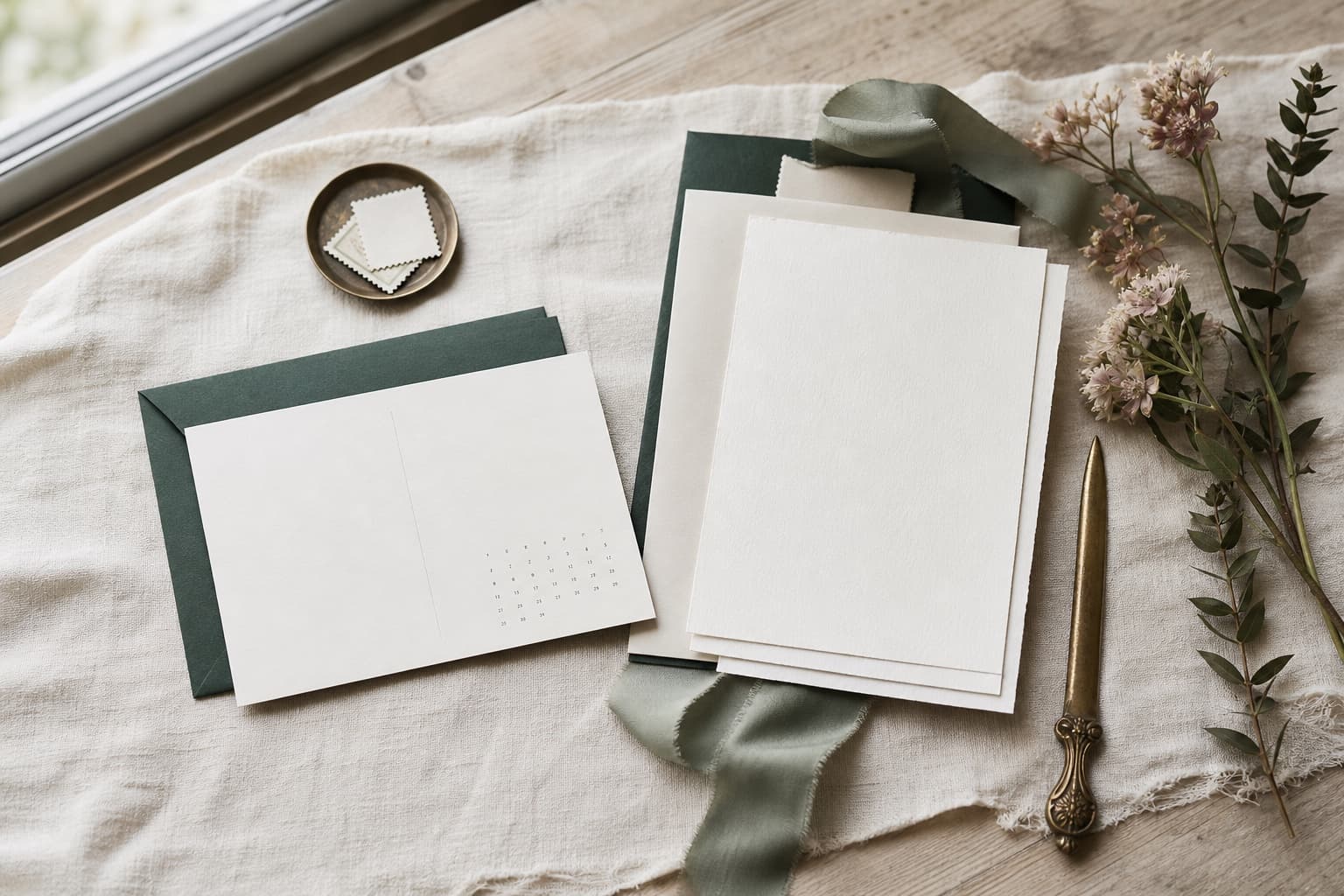
If you are asking when to send save the dates, begin with what the two pieces do. A save-the-date protects calendar space. An invitation gives guests enough confirmed information to decide, reply and attend. Sending one does not remove the need for the other, and making either card carry both jobs usually creates more questions than it answers.
For a typical local wedding, send save-the-dates six to eight months before the date and invitations eight to twelve weeks before it. Those are working windows, not etiquette law. Travel, venue deadlines, postal conditions and your RSVP process can move them.
The more useful way to plan stationery is backwards from the venue's final head-count deadline. That date controls the RSVP deadline, which controls the invitation mailing date, which controls when the suite must be approved and printed.
The short answer by wedding type
Use this table as a first draft, then check the sections below for travel and production adjustments.
| Wedding type | Save-the-date | Invitation | RSVP deadline |
|---|---|---|---|
| Mostly local guests | 6–8 months before | 8–12 weeks before | 3–5 weeks before |
| Many domestic travellers | 8–10 months before | 10–14 weeks before | 4–6 weeks before |
| International or destination | 10–12 months before | 3–5 months before | 6–10 weeks before |
| Short engagement, 4–6 months | As soon as venue is signed | 8–12 weeks before | 3–5 weeks before |
| Very short engagement, under 4 months | Skip or send digitally | 6–10 weeks before | Based on venue deadline |
These windows assume guests receive clear travel information online as it becomes available. They do not require you to have chosen flowers, written the menu or finished the wedding party before warning guests about the date.
If your venue needs final numbers six weeks before the wedding, a three-week RSVP deadline is impossible. The contract wins. Build the mailing plan from the firmest operational deadline, not from a generic graphic.
What a save-the-date actually needs
A useful save-the-date contains only stable facts:
- both partners' names
- the wedding date
- the city and state or country
- a clear statement that a formal invitation will follow
- the wedding website, if it contains accurate information
You do not need the ceremony time, dress code, meal choices, registry details or full schedule. If those details are still moving, leaving them off is a sign of control rather than incompleteness.
The location can be broad if the specific venue should remain private until invitations, but travellers need enough information to price transport and accommodation. “Chicago, Illinois” is useful. “Somewhere in the Midwest” is decorative suspense with a flight attached.
Address the save-the-date to the exact invited household. If children are invited, name them or use wording that clearly includes the family. If a guest has a named partner or confirmed plus-one, include that person. The envelope begins setting expectations long before the invitation arrives.
Do not send cards to a speculative second tier. A save-the-date is difficult to retract politely. Finalise the guest-list rules and capacity first.
What belongs in the invitation suite
The invitation asks the guest to attend a particular event. It needs the hosts or inviting parties, the couple's names, date, start time, venue, location and response instructions. The rest can sit on a details card or website.
A compact suite may contain:
- the main invitation
- a response card and envelope, or a website RSVP instruction
- a details card for travel, dress and additional events
- separate inserts only for guests invited to those events
Use the invitation for confirmed information. “Ceremony at 4:30 p.m.” is confirmed. “Shuttle probably from the north hotel” belongs nowhere until a transport agreement exists.
If you use online RSVPs, print the full website address and a simple deadline. Test the form on a phone, ask someone outside the planning group to complete it, and confirm that submissions reach the correct sheet. A beautiful QR code that opens a private draft page is still a broken RSVP system.
Keep registry information on the website rather than the main invitation. The practical exception is a culturally established insert or host preference, but it should never crowd out attendance details.
Build the dates backwards from final numbers
Start with the date when your venue or caterer needs the guaranteed attendance count. Add time for chasing missing replies, resolving meal choices and submitting the final number.
Worked example for a 12 September wedding:
| Step | Date | Reason |
|---|---|---|
| Venue final count due | 22 August | contractual deadline |
| Internal count locked | 20 August | two-day checking margin |
| RSVP deadline | 8 August | 12 days to chase and reconcile |
| Invitations expected to arrive | 20 June–4 July | gives guests 5–7 weeks to reply |
| Invitations mailed | 13–27 June | allows delivery time |
| Suites assembled and checked | 6 June | one-week production buffer |
This is earlier than “mail eight weeks before” because the venue deadline is early. Nothing is gained by giving guests an RSVP date after you need their answer.
Put the complete sequence in the 12-month wedding checklist, then add your printer's proofing and production times as named tasks. “Order invitations” is not one date; it is design, proof, print, delivery, assembly, postage check and mailing.

Adjust for destination and international travel
Guests crossing borders or buying expensive flights need the date and location earlier. Send destination save-the-dates roughly ten to twelve months ahead when possible, then publish practical travel information as soon as contracts are confirmed.
The website should distinguish facts from suggestions:
- confirmed airport options and ground-transport realities
- contracted hotel blocks, including release dates
- passport or entry-information links to official government sources
- venue accessibility and local transport limitations
- which events are hosted and who is invited
- the earliest and latest time guests genuinely need to be present
Do not tell guests that visas, passports or entry authorisations are “easy” or guaranteed. Link to the relevant government authority and ask travellers to check their own nationality, transit route and validity dates.
For a destination wedding, an early save-the-date does not justify a late invitation. Guests still need a formal, final version of the schedule and RSVP request. Mail the invitation three to five months ahead, depending on travel complexity and the deadlines in your contracts.
If the accommodation block releases rooms six months before the wedding, do not bury that fact in an invitation mailed four months before. Put it on the website and send a factual reminder to invited guests before the release date.
Handle a short engagement without duplicate work
With four to six months to plan, send a digital or quickly printed save-the-date immediately after the venue is contracted. The invitation can follow eight to twelve weeks before the wedding. The two messages may be close together, but they still perform separate functions.
With fewer than four months, skip the formal save-the-date. Contact must-know travellers directly, publish a basic website, and put production effort into an accurate invitation. A card announcing the date two weeks before the invitation adds postage but very little notice.
Use this compressed order:
- sign venue and confirm ceremony arrangements
- freeze the invited list and collect addresses
- contact essential travellers
- publish date, city and travel basics
- order or send invitations
- open and test the RSVP system
Do not compress the response period so far that people cannot check work, care or travel. Compress your design process before compressing their decision time.
If a printer cannot meet the date, use a simpler suite, local printing or a well-designed digital invitation. Paper technique is not more important than guests receiving correct information.
Collect addresses without losing versions
Create one address record per household, not one long formatted cell. Separate first names, surnames, address lines, city, region, postal code and country. That structure makes labels, formal addressing and corrections much easier.
Include fields for:
- household ID
- invited names exactly as intended
- children included or excluded
- save-the-date sent date
- invitation sent date
- delivery issue or returned mail
- RSVP status and reply date
- meal and accessibility details
Ask guests to enter their own address through a form when possible, then review capitalisation and missing apartment numbers. Do not ask three relatives to keep separate lists. That creates three authorities and no clean source.
Before printing envelopes, sort by household and look for duplicated addresses, blank postal codes and couples split into separate invitations accidentally. Compare the invitation count with households, not people. Eighty guests may require 46 suites, not 80.
The wedding website checklist explains which details belong online and how to keep private-event information away from guests who are not included.
Check postage with the finished suite
Do not buy postage from the paper weight listed on a product page. Assemble one complete invitation exactly as a guest will receive it, including every insert and reply envelope, then take it to the postal service or use its current official calculator.
For US mail, check current prices and shape rules with USPS Postal Explorer or at a Post Office. Weight, dimensions, thickness, rigidity and aspect ratio can affect whether a piece is machinable. Square, unusually rigid or uneven envelopes may need different handling and postage.
Also check:
- whether the return address is legible
- whether wax seals or ribbon create uneven thickness
- whether the reply envelope has the correct postage
- whether international reply postage works for the recipient
- whether hand-cancelling is available, needed or merely preferred
Mail a test suite to yourself before sending the batch if timing allows. You will see how the envelope travels, whether ink smears and whether any decorative closure survives automated handling.

Build delivery slack into the timeline. Postal services do not guarantee that 80 invitations placed in one box will arrive together, and holiday periods or local disruptions can alter normal delivery.
Decide between paper and digital by function
Digital save-the-dates are fast, inexpensive and easy to correct. Paper save-the-dates create a physical reminder and reach guests who ignore event emails. Neither format changes the need for an accurate invited list.
Digital invitations can work well for a smaller, informal or short-notice wedding, especially when the RSVP form and updates live in the same system. Paper can make the invitation feel distinct and offers a durable reference for guests less comfortable online.
A hybrid system is often strongest:
- digital save-the-date for speed
- paper invitation for the formal request
- website for living information
- email or text only for material updates
Do not repeat every detail in all four places. Name one source as current, usually the website, and put the stable essentials on the invitation. If the shuttle time changes, update the site and notify affected guests directly rather than hoping they revisit a card.
Budget by household. If 60 invitation suites cost $4 each, postage is $0.90 each and 80 digital save-the-dates cost $0.40 each, the simplified total is:
(60 × $4) + (60 × $0.90) + (80 × $0.40) = $326
Replace the postage placeholder with the rate for your finished piece.
Avoid the timeline mistakes that create reprints
The first mistake is sending before the venue is contracted. A verbal hold is not a date.
The second is putting unstable information in print. Accommodation recommendations, shuttle pickup and brunch plans can wait for a details card or website.
The third is using the same deadline for guest replies and the venue count. Leave at least one to two weeks for chasing and reconciliation, more if meal and transport choices are complex.
The fourth is failing to proof numbers. Check day of week against date, start time, postcode, website address and RSVP deadline separately. Read the suite from the perspective of a guest who has seen none of your planning messages.
The fifth is changing the guest list after save-the-dates. If capacity is uncertain, resolve it before mailing. You may add an unnotified guest later; you cannot gracefully remove someone who has already reserved the date.
Finally, do not assume the stationer, venue or planner owns the final proof. They may catch errors, but you approve the information. Have two people read the final exported file, not only the editable design screen.
The complete production checklist
For save-the-dates:
- venue contract signed
- invited households confirmed
- names, date and location checked
- website live on mobile
- mailing and email addresses collected
- test card or email reviewed
- sent date recorded
For invitations:
- ceremony and reception times confirmed
- final wording approved
- RSVP deadline calculated from contract dates
- details and event access assigned correctly
- one complete suite weighed and measured
- envelopes checked against household list
- spare suites retained for losses and keepsakes
- mailing date recorded
After mailing, watch for returned envelopes and failed emails. Contact those households directly. A returned invitation is a delivery problem, not an implicit decline.
When replies arrive, use one tracking system rather than updating the seating chart, catering count and phone notes independently. The seating-chart guide begins only after replies are stable enough to make tables meaningful.
The sequence to keep
The normal order is venue contract, final invited list, save-the-date, invitation, RSVP deadline, final venue count. The spacing changes; the dependency does not.
Send a local-wedding save-the-date six to eight months ahead and invitations eight to twelve weeks ahead unless travel or contracts require earlier action. Destination weddings deserve more notice. Short engagements deserve less stationery duplication.
Most importantly, calculate the RSVP deadline backwards from the date you owe a number. That one correction prevents the most common stationery timeline error: asking guests to reply after the answer has become operationally useful.


Written by
I planned my own wedding on a spreadsheet that grew to twenty-two tabs, and I build planning spreadsheets for a living. This site is that file, cleaned up, plus what I learned about which decisions actually move the number.