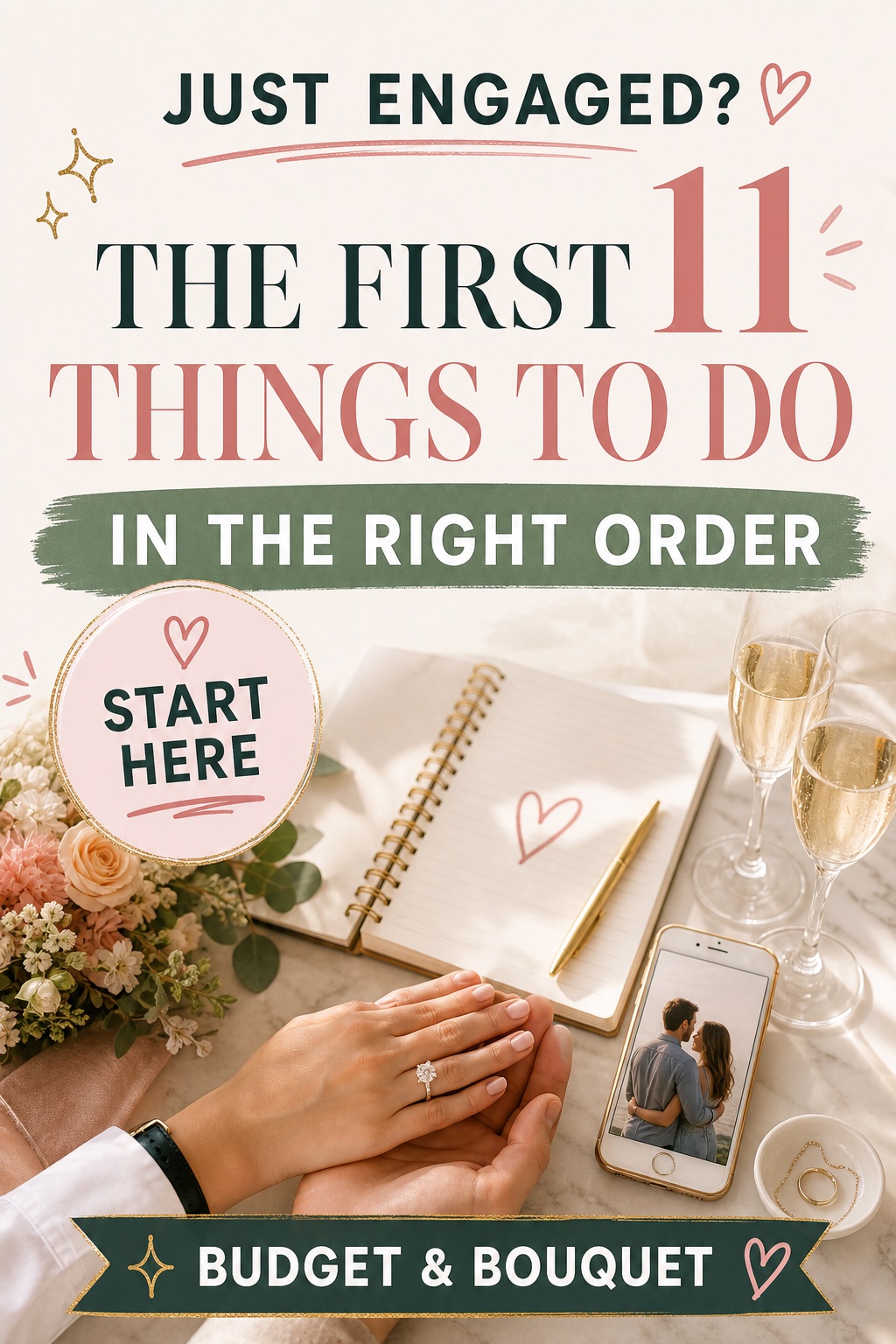
Just Engaged? The First 11 Things to Do
By Iris Calloway · August 10, 2026

Congratulations. Now here is the awkward part: within about a week, someone will ask you when the wedding is, and you will not know, and the question will keep coming until you have an answer.
You do not need one yet. What you need is the small number of things that make the answer easy, and they are not the things the internet will tell you to do first.
1. Do nothing for a fortnight
There is no decision in the first two weeks that gets better for being made early, and several that get worse. Venue availability does not evaporate in fourteen days. Nothing is cheaper this week.
What does happen in that fortnight is that you find out how you both feel about the size of it, which is genuinely useful information and cannot be rushed.
What to say when people ask
They will ask within the week, and "we haven't decided" invites a follow-up question every single time. Give them a season and a shrug: "next autumn, probably, we're just enjoying this bit first." It answers the question, it commits you to nothing, and it ends the conversation warmly rather than awkwardly.
If someone pushes, the honest version works too. Most people asking are making conversation, not requesting a project plan.
2. Agree the two things you each care about
Before any numbers. Each of you names two things about the day that matter more than the rest.
Ours were the photographer and the food. Naming them took ten minutes and made every later trade-off obvious, because everything not on the list was negotiable by definition. When the florist quote came in higher than expected, there was no argument about it. Flowers were not on either list.
Do this now, while it is abstract. It is much harder once you are looking at real quotes and real disappointment.
3. Work out the real ceiling
Not what you hope to spend. What exists.
List every source with an amount and a date:
- what you have saved now
- what you can add each month, times the months you plan to have
- any contribution from family, and when it actually arrives
The dates matter as much as the totals. Roughly a third of wedding costs are deposits in the first few months, and a contribution landing next spring cannot pay a deposit this winter. That timing problem is the one that catches people, not the total.
If a family contribution is on the list, have the conversation properly now. Ask what it comes with. Money that arrives with expectations about the guest list is a different thing from money that does not, and finding out in month seven is worse for everyone.
4. Guess the guest count, badly, on purpose
You do not need a list yet. You need a band: roughly 60, roughly 120, roughly 200.
That single number drives more of the budget than any other choice, because catering, bar, hire, stationery, cake and often the venue tier all scale per head. On our wedding each additional guest cost about $96 once everything per-head was counted.
So the difference between "about 80" and "about 120" is not a mood. It is roughly $3,800.
Get the band roughly right now and refine later. Guessing high is the safer error, because it is easy to shrink a venue shortlist and painful to outgrow one.
When you are ready to turn the band into names, the guest-list method starts with a ceiling and consistent household rules, so the cuts are not made person by person.

5. Insure the ring, this week
This is the one genuinely time-sensitive item on the list, and almost nobody puts it first.
An engagement ring is usually not covered by a standard renters or homeowners policy beyond a low limit, often a few hundred dollars, which is not the number you want to discover after a loss. Two options:
- A rider on your existing policy. Cheapest route if you already have contents cover. You will need a valuation or the receipt, and it typically costs somewhere around 1–2% of the ring's value per year.
- A standalone jewellery policy. Usually broader — mysterious disappearance, damage, travel — and worth comparing rather than assuming the rider is better.
While you are doing it, photograph the ring properly and put the receipt or appraisal somewhere that is not a phone. Ten minutes now, and it is the only item here where delay carries real risk.
6. Decide the shape of the day before the style
One venue or two? A meal at tables or something you eat standing up? Ceremony in the afternoon or the evening?
These sound like details. They are actually the questions that determine which venues can host you at all, and they change the shortlist far more than any aesthetic preference. Answer them before you start looking, or you will fall for a room that cannot do the day you want.
7. Pick a season, not a date
Say "next autumn" rather than "October 12th."
Holding a season instead of a date buys you enormous negotiating room. Venues have gaps they would like to fill, and a couple who can move by a fortnight gets offered things a couple locked to one Saturday never hears about. Fridays and Sundays sit below Saturdays at almost every venue we asked, and a month outside peak is a different quote for the identical room.
Lock the date when you sign the venue. Not before.
8. Tell people in the right order
Parents and anyone who would be genuinely hurt to hear it second-hand, before it goes anywhere public. This costs nothing and prevents a specific kind of long-running grievance.
Then post it if you want to, and enjoy that part.
9. Start one document, not seven
Everything from here goes in one place you both have access to: quotes, contacts, deadlines, who said what. Not a group chat, not screenshots, not one person's memory.
The reason is unglamorous: at some point you will need to know what a venue quoted three months ago, and whether that included staffing. If the answer lives in a text thread, you will not find it, and you will accept a worse number than you were originally offered.
If you want something already built, the free spreadsheet has a budget tab and a guest list tab with the formulas written. Any shared document works, as long as it is one document.
10. Book the vendors who take one booking a day
Only once the venue is signed. These are the constraint, in this order:
- photographer
- caterer, if the venue does not provide it
- band or DJ
- officiant, and check what your county legally requires
Everything else in the wedding can be bought late. These cannot, because they are gone for your date the moment someone else books them.
11. Do not buy anything printed yet
Save-the-dates feel like the first real task, which is exactly why people order them before the venue contract is signed.
We did. The date moved by a fortnight and we reprinted, which cost $180 and a small amount of dignity. Nothing gets printed until a signed contract says that date is real. That covers save-the-dates, invitations, and anything else carrying the date.
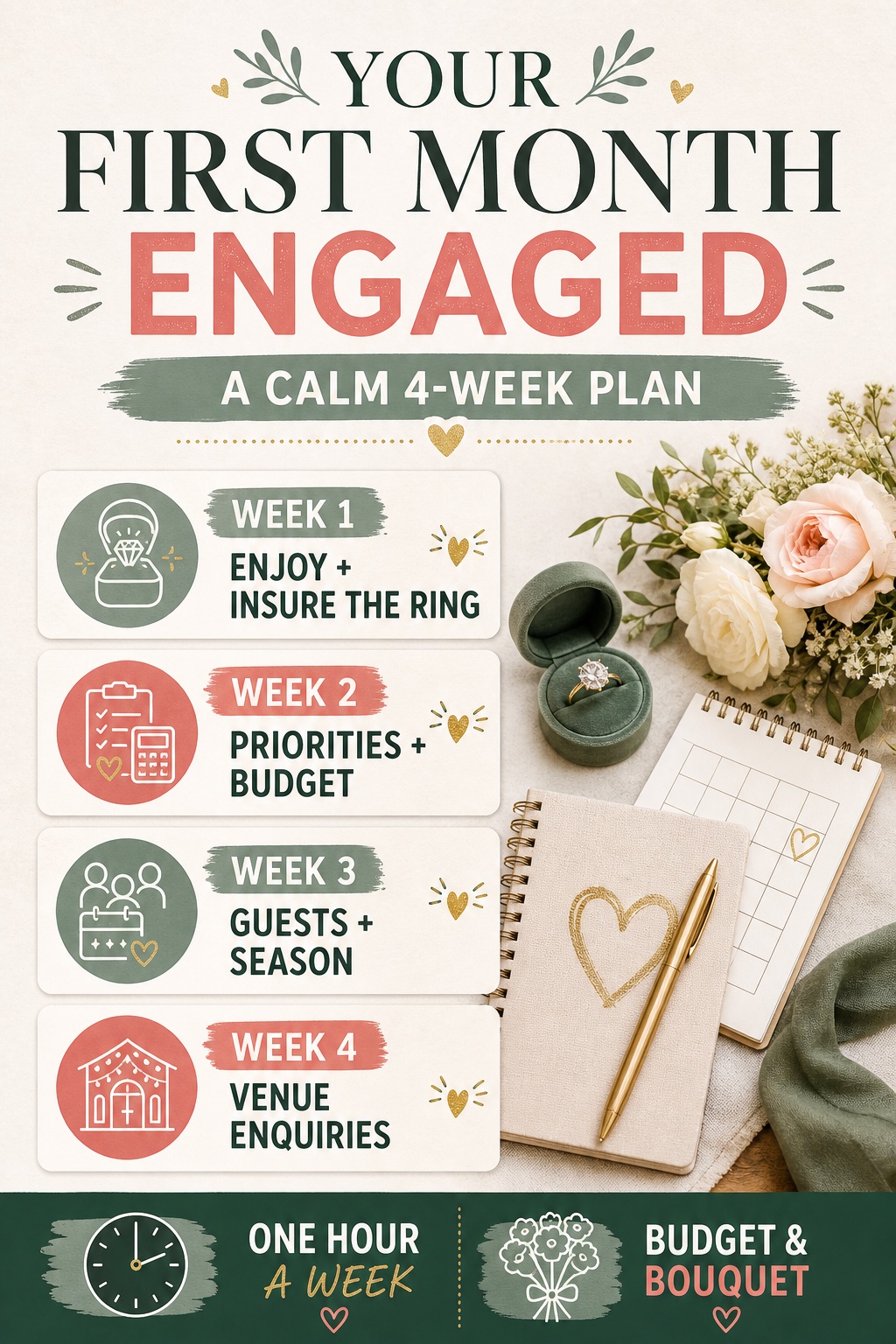
The first month, in four weeks
If the list above feels like a lot at once, it is not meant to be. Spread across a month it is roughly an hour a week.
Week 1 — nothing. Tell the people who need telling. Insure the ring. That is the whole week.
Week 2 — the two conversations. Your two priorities each, then the ceiling. Both are conversations rather than tasks, and they are much easier before anyone has looked at a venue and fallen in love.
Week 3 — the numbers. Guest band, rough season, and the shape of the day. An hour with a shared document open. At the end of it you can answer "when and how big" without committing to a date.
Week 4 — start looking. Now venue enquiries are useful, because you can tell each venue your date range, your guest band and what kind of day you want, and get a quote that means something. Enquire before that and you are collecting brochures.

Nothing here needs to happen faster. The only item with a genuine deadline is the insurance.
Two conversations worth having properly
These are not tasks and they do not belong on a checklist, but skipping them is how people end up arguing about flowers when the argument is about something else.
Whose wedding is this. If parents are contributing, does the money come with a guest list, a venue preference, or a religious expectation? None of those are unreasonable. They are just much easier to navigate as a stated condition than as a discovered one. Ask directly, early, while it is still hypothetical.
What you are each afraid of. One of you is probably worried about the cost and the other about disappointing somebody. Naming it once means the other person stops mistaking anxiety for a preference. Ours came out as a throwaway line about the guest list in week two and it explained the next three months.
What you can safely ignore for now
Colour palettes. Hashtags. Wedding party proposals. Anything on a list titled "12 months out" that is not one of the eleven above. All of it will still be there in two months, and none of it gets cheaper or easier for having been decided early.
When you are ready for the full sequence, the 12-month checklist covers every stage in dependency order, with a printable version for the fridge.

Written by
I planned my own wedding on a spreadsheet that grew to twenty-two tabs, and I build planning spreadsheets for a living. This site is that file, cleaned up, plus what I learned about which decisions actually move the number.