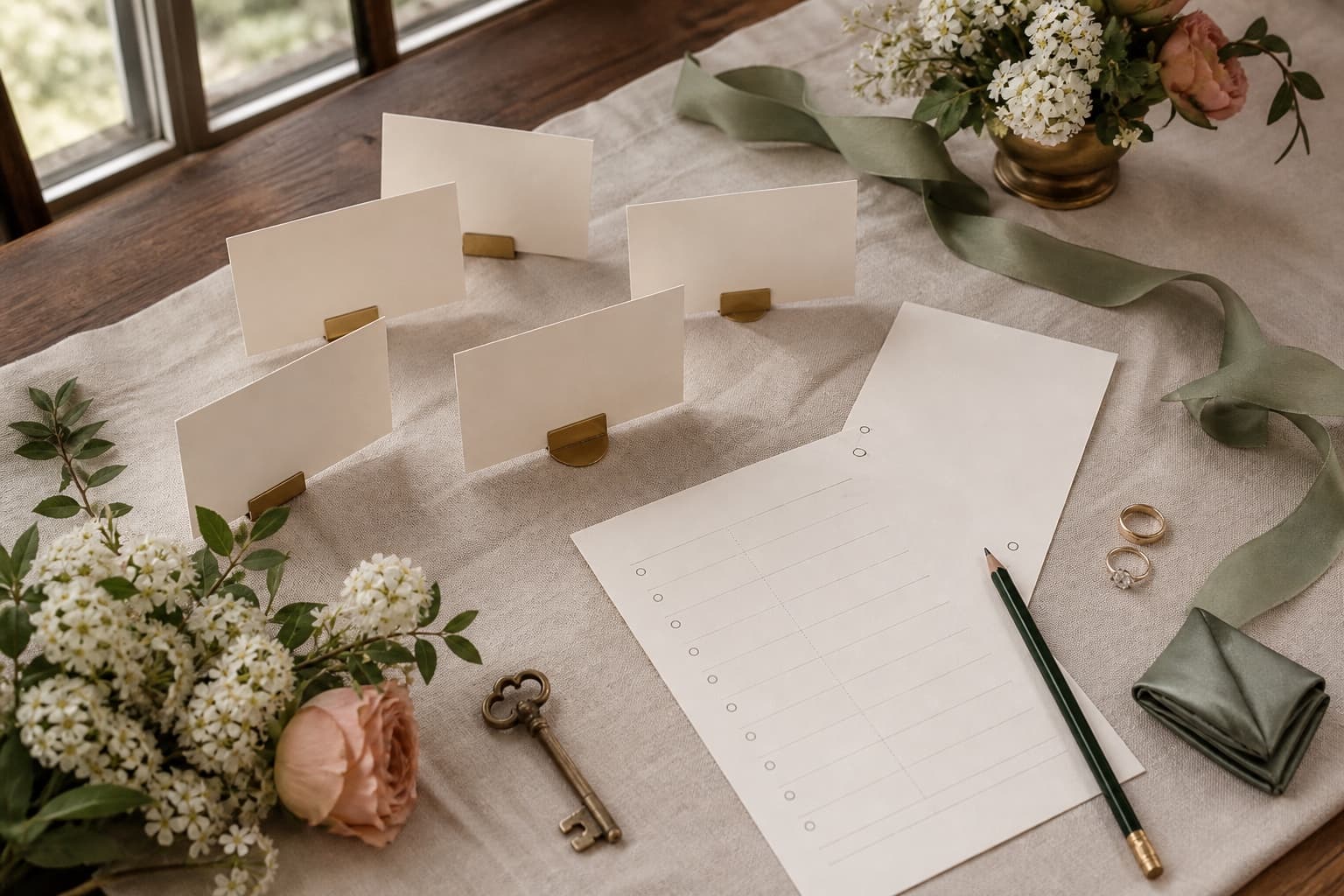
The Wedding Day Timeline: Build Yours Hour by Hour
By Iris Calloway · August 12, 2026

A wedding day timeline is not a list of attractive moments. It is a chain of people, rooms, vehicles, meals and vendor contracts. If one task ends at 3:00 and the next starts at 3:00 in another place, you do not have a tight schedule. You have omitted movement.
Build the day around fixed anchors: venue access, ceremony start, meal service and contractual finish. Then work in both directions, adding travel, setup, photographs and buffers as actual blocks. The aim is not to account for every minute. It is to make the important minutes possible.
The example below uses a 4:00 p.m. ceremony at the reception venue, a first look, 5:30 p.m. dinner and an 11:00 p.m. end. Copy the structure, not the exact hours. Your vendors and venue rules decide the final version.
The complete sample timeline
This schedule assumes ceremony and reception share a site, portraits happen before guests arrive, and the venue handles the room setup. It is intentionally less crowded than many templates.
| Time | Couple and wedding party | Venue and vendors | Guests |
|---|---|---|---|
| 8:30 | breakfast and preparation begins | beauty team arrives | |
| 10:30 | second preparation group begins | photographer covers details | |
| 12:30 | light meal; final hair and make-up | flowers delivered and checked | |
| 1:30 | get dressed | photographer captures dressing | |
| 2:15 | first look | portrait location cleared | |
| 2:30 | couple and wedding-party portraits | ceremony sound check | |
| 3:15 | portraits finish; private break | doors and guest services ready | earliest arrivals |
| 3:30 | hidden from guest route | prelude music; ushers in place | doors open |
| 4:00 | ceremony | officiant and musicians lead | seated |
| 4:30 | recessional and private pause | drinks service opens | move to cocktail hour |
| 4:45 | immediate-family photographs | room reset if needed | drinks and canapés |
| 5:15 | enter reception or take ten minutes alone | guests invited to seats | take seats |
| 5:30 | welcome and dinner | first course or buffet opens | dinner |
| 6:45 | speeches | sound and catering coordinate | speeches |
| 7:15 | first dance, then open floor | DJ or band begins main set | dancing |
| 8:30 | cake or dessert | catering serves dessert | dessert and dancing |
| 10:30 | last bar call and final songs | transport reminder | departures begin |
| 11:00 | depart | contracted event end | depart |
| 11:00–11:45 | vendor strike and collection |
The 4:30 ceremony finish does not make a 4:30 family photograph possible. The couple needs to leave the aisle, guests need direction and the photographer needs the named people in one location. Fifteen minutes of transition is not wasted time; it is what keeps the next block real.
Start with the four immovable anchors
Ask the venue and key vendors for these exact times before building anything around them:
- earliest access for each room and loading area
- ceremony start and any restriction on door opening
- meal service time or kitchen service window
- event end, bar close, music cut-off and building-clear time
Those may be different. Music may stop at 10:45, guests may leave by 11:00 and rentals may need collecting by noon the next day. Record each obligation instead of compressing them into “venue until 11.”
Read contracts for minimum coverage, overtime increments and meal requirements. A photographer booked until 8:00 cannot cover a 9:30 exit unless you move the exit, extend the contract or stage a smaller night portrait before coverage ends.
Use the venue question list to confirm loading, access, turnover and local noise rules. A venue may prefer a familiar schedule, but preference and contractual requirement should be labelled separately.
Once the four anchors are in place, protect them. Small decorative decisions must fit around meal temperature, ceremony access and the legal end time, not the other way round.

Calculate preparation from the finish time backwards
“Hair and make-up starts at nine” is not enough. Ask the beauty team how many services, how many artists and how many minutes per service, including touch-ups. Add setup at the start and dressing at the end.
Worked example for eight services:
- four hair services × 45 minutes = 180 service-minutes
- four make-up services × 45 minutes = 180 service-minutes
- total = 360 service-minutes
- two artists working in parallel: 360 ÷ 2 = 180 elapsed minutes
- setup and final touch-ups: 30 minutes
- total block: 3 hours 30 minutes
If everyone must be finished by 1:00 p.m., the team starts at 9:30 a.m. This arithmetic assumes the right artist can perform the right service in parallel. Confirm the service order rather than dividing blindly.
Schedule the person getting married away from the final slot. If the morning runs ten minutes late, the entire event should not wait on the one person required at the ceremony.
Add food, water and room-clearing to preparation. A lunch delivered at 12:15 is only useful if there is a 20-minute gap to eat it. Choose food that does not require elaborate serving, and assign one person to receive delivery so the couple is not answering a driver during make-up.
Give photography named blocks
Photography expands to fill vague time. Replace “photos” with a shot group, people required, location and hard finish.
A useful pre-ceremony plan might be:
| Block | Minutes | People |
|---|---|---|
| first look | 15 | couple, photographer |
| couple portraits | 25 | couple |
| wedding party | 25 | couple and attendants |
| immediate family | 20 | pre-confirmed list |
| travel and buffer | 15 | everyone required |
That is 100 minutes, not “about an hour.” If you have only 60 minutes, choose which groups move after the ceremony.
For family photographs, send the photographer a short list using names and relationships. “Partner A with parents and siblings” is faster than a Pinterest board of poses. Tell every named person where and when to wait, and appoint one relative from each side who can identify missing people.
A first look is a scheduling tool, not an obligation. It moves portraits earlier and protects more of cocktail hour. If seeing each other at the ceremony matters more, keep that choice and allow a longer post-ceremony photo block with suitable guest hosting.
Photography timing also depends on season, weather and actual light at the location. Ask your photographer for the portrait window rather than copying sunset time from an unrelated wedding.
Build the ceremony as more than a start time
The ceremony block begins before the processional. Doors open, guests arrive, music starts, the officiant checks documents or notes, and the wedding party lines up. Put each action on the working timeline even if the guest version says only 4:00 p.m.
For a 4:00 ceremony:
- 3:15 venue and sound ready
- 3:25 ushers and officiant in position
- 3:30 doors open and prelude begins
- 3:40 wedding party gathers privately
- 3:55 processional ready
- 4:00 ceremony begins
- 4:25 signing or final remarks, if applicable
- 4:30 recessional
The marriage process and document timing vary by jurisdiction and officiant. Confirm who brings, witnesses, signs, files and retains each document. Do not insert a ceremonial signing merely because a template includes one.
Estimate ceremony length from the actual order: entrances, welcome, readings, ritual, vows, rings, legal wording and exit. Ask each reader for their text and read it aloud. A “short reading” is not a unit of time.
If the ceremony is off-site, add loading, traffic, parking and unloading for the slowest necessary group. The couple's car arriving in 12 minutes does not matter if a coach of guests takes 28.
Treat travel as a scheduled event
Map each route at the same day and time of week as the wedding, then add loading and a traffic margin. Ask transport companies when the vehicle must leave, not simply how long the drive takes.
Worked example:
| Travel component | Minutes |
|---|---|
| gather and board 42 guests | 15 |
| normal drive | 22 |
| traffic margin | 10 |
| unload and walk to seats | 8 |
| total movement block | 55 |
A 22-minute map therefore needs nearly an hour in the guest schedule. Elderly guests, mobility equipment, children, parking payment and venue security can extend boarding or arrival. Ask rather than assuming.
Assign a transport lead who is not in the processional. Give that person the driver contact, passenger list and decision rules for late guests. A coach should not delay the ceremony indefinitely because one phone is unanswered.
If guests arrange their own transport, provide the actual parking address, cost, walking route and rideshare limitations. Rural venues sometimes have unreliable pickup supply at night; a timetable cannot create cars that are not there.
The wedding website checklist helps you publish the guest-facing version without exposing vendor phone numbers or private preparation locations.
Protect the kitchen and meal service
Dinner is the least flexible large block because food has a service window. Ask the caterer how speeches, entrances and photographs affect that window, then put their answer into the schedule.
For plated service, guests need to be seated before the first course leaves the kitchen. For a buffet, table release requires an owner and enough time for the final table to eat before speeches begin. For family-style service, tables need clear surfaces and serving space.
Avoid scheduling a long welcome, three speeches and a first dance between guest seating and food. If 100 guests sit at 5:25 and dinner begins at 6:05, you have turned a 5:30 meal into a 40-minute wait.
A sensible order is:
- guests invited to seats
- brief welcome
- food served
- speeches between courses only with catering approval, or after plates clear
- transition to dancing
Feed vendors according to their contracts and in time for their next task. Serving the photographer after all guests may leave them eating during speeches. Ask the caterer and planner to coordinate vendor meals as an operational line, not a courtesy note.
Put allergies and dietary requirements in the catering system from the RSVP tracking process. The day timeline should show who communicates final changes and where special meals are identified.

Time speeches, dances and traditions honestly
Three people described as giving five-minute speeches will often use 25 minutes once introductions and handovers are included. Ask for a limit, share it kindly, and give one person responsibility for moving the programme forward.
A compact formalities block might be:
| Item | Time |
|---|---|
| host introduction | 2 minutes |
| speech one | 5 minutes |
| speech two | 5 minutes |
| couple thank-you | 4 minutes |
| microphone handovers and applause | 4 minutes |
| total | 20 minutes |
The same honesty applies to dances. A four-minute track plus an introduction and floor opening occupies six or seven minutes. If parent dances follow, choose whether they use full tracks, shortened edits or share one song.
Only include traditions that matter to you. Cake cutting, bouquet toss, formal entrance and staged exit are optional events with setup and audience requirements. Removing one can recover 15 useful minutes and reduce the number of times guests are asked to stop talking and look in one direction.
Tell the DJ, band, photographer, caterer and planner the agreed formalities order. If five vendors hold five versions, the loudest version tends to win.
Add buffers at the points that can spread delay
A buffer is placed time, not a vague hope that the day can catch up. Add it after activities with variable duration and before fixed anchors.
Useful buffers include:
- 15 minutes after dressing before departure
- 10–15 minutes after group photographs
- 10 minutes before the processional
- 15 minutes between ceremony and formal portraits
- 10 minutes before guests are called to dinner
- 15 minutes before contracted transport departure
Do not add five minutes to every row. That hides the buffer and encourages each supplier to claim it. Create named blocks such as “private break and reset, 3:15–3:30.”
If the morning loses 20 minutes, know which item shrinks. It might be detail photographs or a longer portrait list. It should not be the legal ceremony wording, guest meal or venue's contractual exit.
Create a rain version before the forecast exists. Name the indoor portrait location, who makes the call, when they make it and how guests learn. “We will see on the day” assigns neither authority nor time.
Give each audience the version they need
The master document can contain phone numbers, access codes, balances, sensitive family notes and every vendor arrival. Do not send that version to all guests.
Create four views:
Couple and planner: every dependency, owner and decision rule.
Vendors: shared operational timing, delivery access, named contacts and the portions relevant to their work.
Wedding party and family: arrival, clothing, transport, photographs and ceremony duties.
Guests: event start, door opening, location, transport and any firm end information.
Use one master source and generate the views from it. Do not edit four independent files in the final week. Every change needs a version date at the top and direct notice to affected people.
Keep private phone numbers and access instructions off the public website. Give guests one help contact who is not either person getting married.
The wedding-party duties guide can turn timeline responsibilities into short cards rather than asking attendants to interpret the vendor schedule.
Confirm it twice, then stop redesigning it
Send a working version to the venue, caterer, photographer, music provider, officiant and planner around four to six weeks before the wedding. Ask each to identify impossible transitions, contract conflicts and missing dependencies.
Update it after the final RSVP count, transport booking and meal plan. Hold a final confirmation roughly one week before, or on the schedule required by your vendors. After that, change only facts that genuinely changed.
Run a tabletop check:
- Who opens every locked room?
- Who holds the rings and documents?
- Who receives each delivery?
- Who moves people for photographs?
- Who tells catering that speeches are ending?
- Who makes the weather call?
- Who authorises overtime or refuses it?
- Who leaves last with personal items?
Any answer that begins “probably” needs a name.
The 12-month planning checklist keeps these confirmations beside payments and final guest tasks, where they are less likely to become an isolated document nobody revisits.
The hour-by-hour rule that matters
The best timeline is not the one with the most rows. It is the one in which each fixed event has enough preparation before it, each movement occupies time, and each responsibility belongs to someone who can act.
Start with access, ceremony, meal and finish. Add preparation and photographs using vendor estimates. Add travel from boarding to arrival, not map time alone. Place buffers before the anchors that cannot move.
Then remove anything that asks the same 15 minutes to do two jobs. A calm day is not created by typing “relaxed” beside cocktail hour. It is created by leaving enough space for real people to move through the plan you made.


Written by
I planned my own wedding on a spreadsheet that grew to twenty-two tabs, and I build planning spreadsheets for a living. This site is that file, cleaned up, plus what I learned about which decisions actually move the number.