The Wedding Alcohol Calculator (How Much to Buy)
By Iris Calloway · August 12, 2026
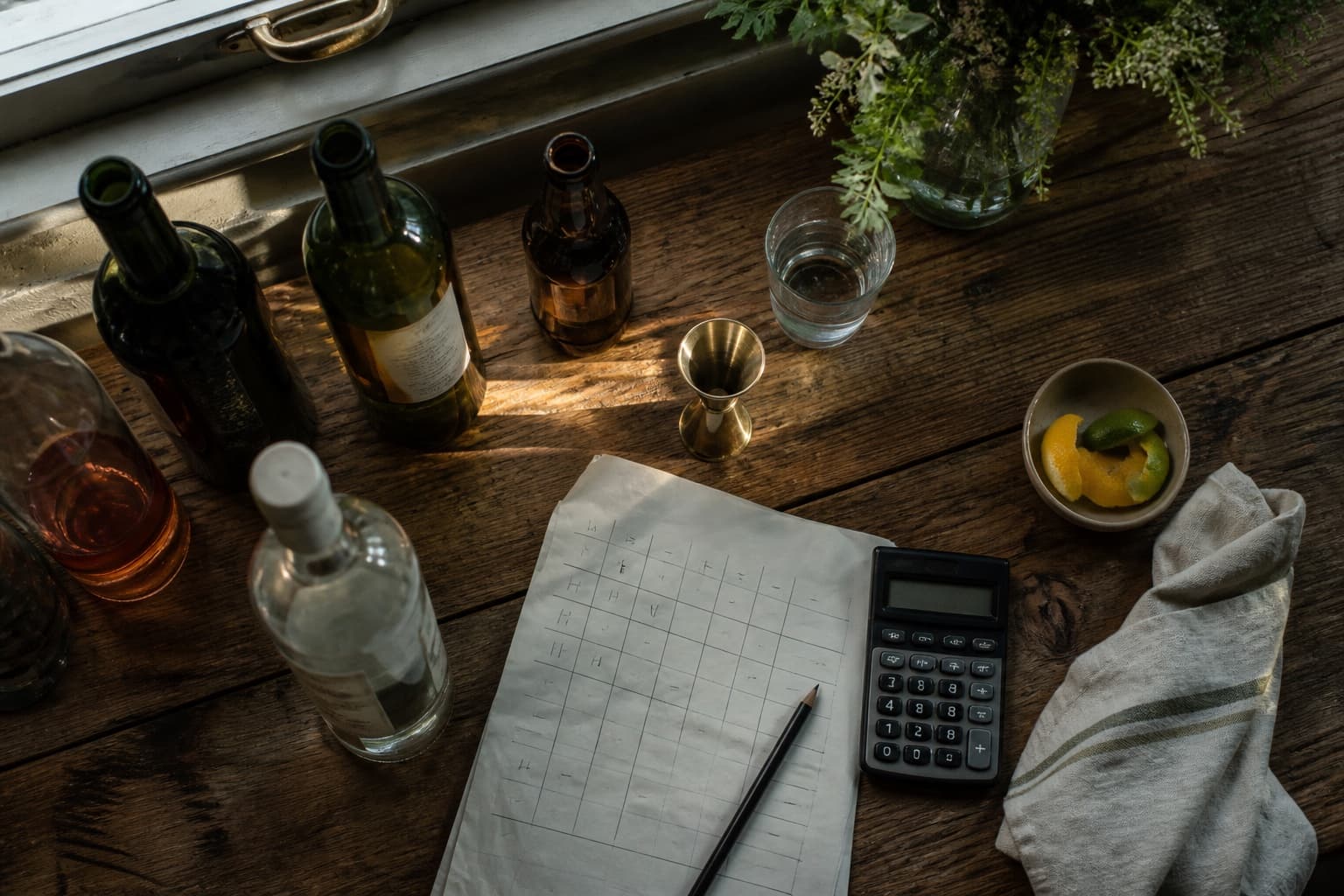
The useful output of a wedding alcohol calculator is not one impressive stack of bottles. It is a defensible estimate: how many alcoholic servings your attending drinkers may request, how those servings split by type, and what stock or package covers them without pretending every guest drinks at the same rate.
You can calculate that manually in ten minutes. The arithmetic is simple. The judgement sits in five inputs: attending drinker count, service length, drinks per person per hour, beverage mix and buffer. Make each input visible and you can change it when better information arrives.
The five-input wedding alcohol formula
Start with this planning formula:
estimated alcoholic servings = attending drinkers × event hours × average drinks per drinker per hour

purchase target = estimated servings × (1 + buffer percentage)
Use attending guests, not invited guests. Then remove children, people you know do not drink, and anyone leaving before the bar period. If you invited 140, expect 118 to attend and estimate 22 non-drinkers, your working drinker count is 118 − 22 = 96 attending drinkers.
Event hours means hours when alcohol is actually available. A six-hour reception with the bar closed for a one-hour meal has five service hours. If wine is served during that meal, the hour still counts for wine even though mixed drinks are unavailable. Build around the real service plan.
The drinking rate is an average for purchasing, not a target for any guest. A cautious starting range is often 0.5 to 1 alcoholic serving per attending drinker per service hour, adjusted for your group, event time, meal and transport. Do not use the high end by habit. Ask your licensed provider what its records suggest for comparable events.
Finally, add a controlled buffer. Ten per cent is easy to audit. A vague instruction to buy “plenty extra” is not. The buffer protects against mix errors and underestimation; it should not double the order.
Worked example: 120 attendees and a five-hour bar
Suppose 120 guests will attend. Twenty are underage or non-drinking, leaving 100 attending drinkers. Alcohol is available for five hours. You select an average rate of 0.75 servings per drinker per hour and a 10% buffer.
Calculate the base first:
100 drinkers × 5 hours × 0.75 servings per drinker per hour
= 375 alcoholic servings
Then add the buffer:
375 servings × 10% = 37.5 buffer servings
375 + 37.5 = 412.5 servings
Round to 413 planned servings before splitting beer, wine and spirits. Keep the unbuffered figure visible. If a retailer accepts unopened returns where lawful and permitted, the buffer may carry less financial risk; if nothing is returnable, buying every category 20% heavy is expensive insurance.
Now test the rate. At 0.6 per hour, the same wedding needs 100 × 5 × 0.6 = 300 base servings, or 330 after a 10% buffer. At 1.0 per hour, it needs 500 base servings, or 550 buffered. That 220-serving spread is why a calculator that hides its assumed rate is not very useful.
Ask the venue or caterer for its recommended rate, then compare it with what you know. An afternoon lunch with a full meal, many drivers and a short toast does not behave like a late-evening reception with shuttle transport. The estimate should describe your event, not the internet’s imaginary average wedding.

Choose a beverage mix before converting to bottles
The mix is the percentage of alcoholic servings expected as beer, wine and spirits-based drinks. A broad starting point for a full bar might be 35% beer, 35% wine and 30% spirits. A beer-and-wine reception could use 55% beer and 45% wine. Neither split is a universal fact.
For the 413-serving example, using a 35/35/30 full-bar mix:
| Type | Share | Calculation | Planned servings |
|---|---|---|---|
| Beer | 35% | 413 × 0.35 | 144.55 → 145 |
| Wine | 35% | 413 × 0.35 | 144.55 → 145 |
| Spirits | 30% | 413 × 0.30 | 123.9 → 124 |
| Total | 100% | 414 after rounding |
Rounding each category up produces 414, one more than the overall target. That is fine. Record it so your spreadsheet does not appear to contain an error.
Adjust the split with evidence. Look at the actual guest list, not stereotypes about age or gender. Count known beer, wine and cocktail preferences if you can do so without surveying everybody. Consider season, food and whether you will offer one signature cocktail rather than a full spirits range.
A narrow menu improves forecasting. Beer, two wines and one batchable cocktail use fewer stock-keeping units than a bar that promises every common mixed drink. Fewer units mean less stranded stock, fewer garnishes and faster service.
Convert servings into beer cases and wine bottles
For packaged beer, one bottle or can is usually one serving for inventory purposes. Check size and alcohol by volume rather than assuming all containers are equivalent. The US National Institute on Alcohol Abuse and Alcoholism explains that a US standard drink contains 14 grams of pure alcohol, approximately the amount in 12 fluid ounces of 5% beer, 5 ounces of 12% wine or 1.5 ounces of 40% spirits. Stronger or larger pours contain more.
For 145 beer servings in 24-count cases:
145 cans ÷ 24 cans per case = 6.04 cases
You cannot buy 0.04 of a case, so buy 7 cases, or 168 cans, if cases are the available unit. That adds 23 beers beyond the category estimate. Count that package rounding as part of the buffer before adding more.
For wine, NIAAA notes that a 750 ml bottle at 12% alcohol contains about five US standard drinks. Actual event pours and glass size vary, so confirm the caterer’s pour. Using five 5-ounce servings per bottle:
145 wine servings ÷ 5 servings per bottle = 29 bottles
That is exactly 29 bottles. If your caterer pours six ounces, a 750 ml bottle provides roughly four pours, and 145 ÷ 4 = 36.25, rounded to 37 bottles. The pour standard changes the order by eight bottles, which is worth confirming in writing.
Split white, red, rosé or sparkling only after calculating total wine. If your 145 servings are 50% white, 35% red and 15% sparkling, the split is 72.5, 50.75 and 21.75 servings. At five servings per bottle, that becomes 15 white, 11 red and 5 sparkling bottles after rounding.
Convert spirit servings without confusing drinks and bottles
A 750 ml bottle of 40% spirits contains about 17 US standard drinks according to NIAAA’s container guidance. Bar pours, recipes and alcohol strength vary. A cocktail can contain one standard drink or more, so inventory must follow the recipe your licensed bar will serve.
If all 124 planned spirits servings used a measured 1.5-ounce pour:
124 spirit servings ÷ 17 servings per 750 ml bottle
= 7.29 bottles
Round to 8 bottles total. Do not buy eight bottles of each spirit. Split eight across the actual menu. For a bar serving vodka soda, gin and tonic, whisky highballs and a tequila signature drink, a plausible evidence-free split would still be a guess. Ask the bartender for the expected recipe share.
Suppose the agreed mix is 35% vodka, 25% tequila, 20% gin and 20% whisky:
| Spirit | Share of 124 | Calculated bottles | Rounded bottles |
|---|---|---|---|
| Vodka | 43.4 servings | 43.4 ÷ 17 = 2.55 | 3 |
| Tequila | 31 servings | 31 ÷ 17 = 1.82 | 2 |
| Gin | 24.8 servings | 24.8 ÷ 17 = 1.46 | 2 |
| Whisky | 24.8 servings | 24.8 ÷ 17 = 1.46 | 2 |
Rounding by type produces nine bottles, not eight. That extra bottle is another buffer created by packaging. Recalculate total available spirit servings: 9 × 17 = 153, compared with the 124 target. You now have 29 extra spirit servings and probably do not need another blanket 10% on top.
Mixers are calculated from recipes, not from the number of spirit bottles. If 70 highballs use 5 ounces of mixer each, the requirement is 70 × 5 = 350 ounces. In one-litre bottles at roughly 33.8 ounces, 350 ÷ 33.8 = 10.36, rounded to 11 one-litre bottles, plus any carefully chosen service buffer.
Count sparkling wine for the toast separately
The toast may be an additional service or may replace part of the wine share. Decide which before adding bottles. Automatically ordering one glass for every attendee often overstates demand because children, non-drinkers and guests with another drink may decline it.
Count accepted toast pours. If you expect 82 of 120 attendees to take sparkling wine and the caterer pours 4 ounces, a 750 ml bottle provides approximately six 4-ounce pours:
82 toast pours ÷ 6 pours per bottle = 13.67 bottles
Round to 14 bottles. If those 82 pours are already included in the 145 wine servings, allocate them within the wine total. If they are served in addition, add them. Write “included” or “additional” beside the line because this small word can change the order by fourteen bottles.
Offer a non-alcoholic toast at the same moment rather than treating it as an improvised substitute. The bar plan also needs water, soft drinks and appealing alcohol-free choices for the entire event, not merely a jug placed at one end after everything else is ordered.
Add a buffer once, not at every step
Buffers multiply quietly. If you add 10% to the total, round every package upward, add “one spare of each,” and let the retailer add another case, you no longer have a 10% buffer. You may have 25–35% more stock without ever choosing that number.
Use a buffer ledger:
| Source of extra stock | Extra servings |
|---|---|
| Deliberate 10% total buffer | 38 |
| Beer case rounding | 23 |
| Spirit bottle-by-type rounding | 29 |
| Wine rounding | 0 |
| Visible extra | 90 |
In the worked example, the base estimate was 375 servings. Ninety visible extras equal 90 ÷ 375 = 24% above the base. You may decide that is too much and remove the initial 10% from categories already heavily rounded.
There is a difference between shortage risk and variety risk. You can have enough total alcohol and still run out of the most popular beer. Reduce variety risk by putting more of the forecast into two or three proven choices, not by buying a full extra case of every label.
Ask about unopened returns, buy-back arrangements, delivery-day top-ups and ownership of leftovers. Policies and alcohol laws vary. Do not assume alcohol may be returned or transported across a border merely because a general retail policy allows other products.
Compare a venue package with buying your own
A flat package purchases certainty and service, not only liquid. A DIY comparison must include alcohol, mixers, ice, garnishes, cups or glass hire, chilling, delivery, bartenders, permits if applicable, corkage, cleanup and waste.
Worked example for 100 attending drinkers over five hours:
| Option | Calculation | Cost |
|---|---|---|
| Venue package | 100 people × $38 | $3,800 |
| Purchased alcohol | itemised retailer order | $1,620 |
| Mixers, ice, garnish | itemised supplier order | $310 |
| Two bartenders | 2 × 7 hours × $42 | $588 |
| Glass hire and delivery | quoted fixed cost | $420 |
| Corkage | 30 wine bottles × $12 | $360 |
| DIY total | $1,620 + $310 + $588 + $420 + $360 | $3,298 |
The apparent saving is $3,800 − $3,298 = $502. Now test risk. Does the bartender quote include setup and teardown? Who carries liability coverage? What happens to unopened stock? Is tax included? If one missing line costs more than $502, the package is cheaper in practice.

Compare the same service scope. A beer-and-wine DIY order is not comparable with a full-bar package. A consumption bar, where you pay for what is poured, shifts waste risk to the venue but leaves the final total uncertain. Put a low, expected and high consumption case into the wedding planner spreadsheet.
The wedding budget breakdown shows how the bar sits inside the largest variable category. The venue question list covers corkage, closing time, staffing and package terms before they become contract surprises.
Check the rules and service plan before purchasing
In the United States, alcohol regulation differs widely by state and may include local requirements. The federal Alcohol and Tobacco Tax and Trade Bureau provides a directory of state and local alcohol beverage authorities and explicitly advises checking the requirements where the activity occurs.
Ask your venue and licensed provider, in writing:
- who may purchase, transport, store and serve the alcohol;
- whether all service must be performed by licensed or insured staff;
- whether a permit is required and who obtains it;
- what the venue’s last-service time and refusal policy are;
- whether outside alcohol, self-service or shots are prohibited;
- who provides water, alcohol-free drinks and food;
- how unopened and opened stock leaves the venue;
- what host-liability or event insurance is required.
Plan safe transport before planning a generous bar. Tell guests about shuttles, taxis, designated-driver arrangements and parking rules on the wedding website. Your bar team, not the wedding party, should manage service decisions and refusals.
Put the final order on one auditable sheet
Keep inputs at the top, calculations in the middle and purchase units at the bottom. Label every assumption with a date and source, such as “100 attending drinkers from RSVP list, updated 14 May” or “five-ounce wine pour confirmed by caterer.”
Then run four checks. The category percentages must total 100%. The rounded stock must cover the planned servings. The buffer must be measured once. The DIY total must include service, hire and fees as well as bottles.
Recalculate when final attendance locks, not every time one RSVP changes. A calculator is not meant to produce false precision. It is meant to show which assumptions drive the order, so you and the licensed people serving it can replace guesses with actual event information.
Written by
I planned my own wedding on a spreadsheet that grew to twenty-two tabs, and I build planning spreadsheets for a living. This site is that file, cleaned up, plus what I learned about which decisions actually move the number.