Micro-Wedding Guide: 50 Guests or Fewer
By Iris Calloway · August 12, 2026
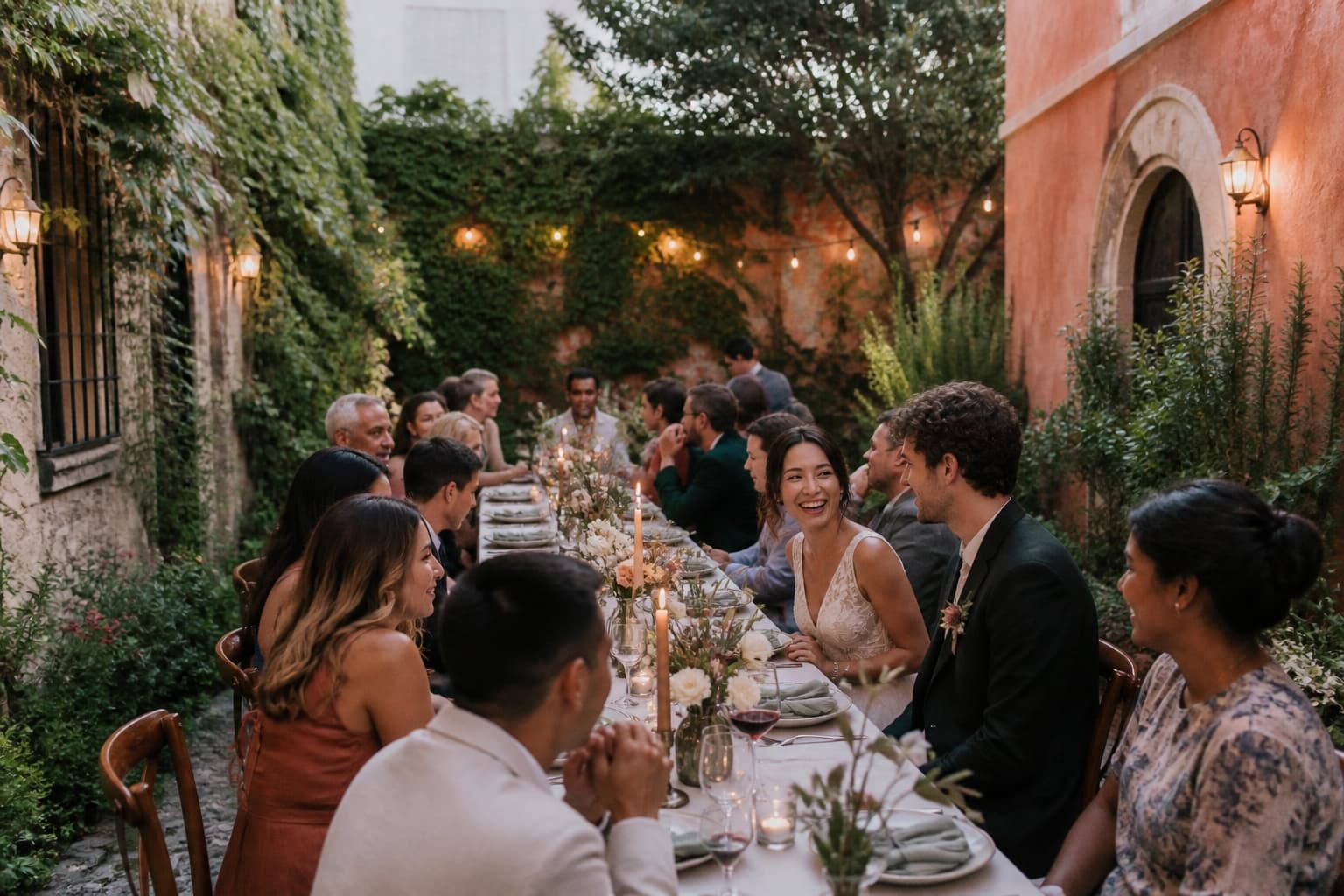
The best micro wedding ideas do not begin by removing chairs from a full-sized wedding. At 50 guests or fewer, the economics change, the room behaves differently and the parts that make the day feel generous become much more visible.
That is useful, but it is not automatic. A small guest list can reduce catering, bar, stationery and hire costs. It can also tempt you into upgrading every remaining detail until 30 guests cost what 100 would have cost. The point is not simply to invite fewer people. It is to use the smaller scale deliberately.
This micro-wedding guide starts with the number, gives every guest a real cost, and builds the format around the people who remain.

Decide whether a micro-wedding solves your actual problem
Start with the reason, because it controls almost every decision after it. A micro-wedding works particularly well when you want more time with each guest, have a fixed budget, dislike the mechanics of a large reception, or need a venue that cannot hold a conventional crowd.
It is less useful as a compromise that neither partner wants. If one of you imagines a room full of cousins and the other imagines dinner with twelve friends, calling the smaller option “intimate” will not settle the underlying disagreement. Settle the purpose before you choose the format.
Ask each other four questions separately, then compare the answers:
- Which five moments do we want to remember most?
- Who would make the day feel incomplete by being absent?
- Do we want to host, perform, travel, eat, dance or simply be together?
- What must still be true the month after the wedding?
That last question protects the budget. If you want cash left for a home move, emergency fund or honeymoon, write the amount down now. A wedding budget is not whatever remains in your account on the final payment date.
Build the guest list from the room inwards
For a 150-person wedding, one extra invitation can feel numerically harmless. On a 30-person list, it changes the social shape of the table. The wedding guest list method still begins with a ceiling, but a micro-wedding needs one additional rule: every category must be small enough to remain coherent.
Create an A list from households, not names. Start with the two of you, then immediate family, closest friends and any people with a defined role. Add partners according to one consistent rule. Count children according to one consistent rule. Do not use “we will decide case by case” unless you want every decision to become a case.
Then run the table test. Imagine one long meal at which every invited person can hear a speech without a sound system. Does the group make sense together? Are there two guests who know nobody except you and will lose you to hosting duties? Small weddings magnify both warmth and awkwardness.
Use invited numbers for venue capacity and stationery. Use expected attendance only for a cautious food forecast. Until an RSVP says otherwise, an invitation occupies a chair.
Give every guest a complete per-head cost
The saving is not the difference between two menu prices. One guest can affect food, drinks, furniture, linen, stationery, transport, favours and tax or service charges. Calculate the complete variable amount before deciding what a smaller list buys you.
Here is a worked example, not a market average:
| Variable item | Per guest |
|---|---|
| Dinner | $82 |
| Drinks | $36 |
| Chair, place setting and linen | $14 |
| Invitation, place card and menu | $6 |
| Service charge and tax allowance | $24 |
| Complete variable cost | $162 |
At $162 per attending guest, reducing the list from 80 to 40 releases 40 guests × $162 = $6,480. That is the useful saving. It is not 40 multiplied by the dinner price alone.
Fixed costs do not fall with the list. Photography, ceremony fees, attire and often music cost roughly the same for 20 people as for 100. Put those in a separate column. The wedding budget breakdown explains how to rebalance the categories once your total is fixed, and the wedding planner spreadsheet gives the arithmetic somewhere to live.
Choose a venue that is designed for the number
An undersized guest list in an oversized ballroom feels like a cancelled conference. The venue may try to solve the empty floor with screens, extra furniture or a larger floral order, which replaces the savings with scenery.
Look for private dining rooms, restaurants with a full buyout option, small hotels, galleries, gardens with an indoor room, houses licensed for events, community spaces or a larger venue with a genuinely separate small room. “We can curtain off half the ballroom” is a technical answer, not necessarily an atmospheric one.
Ask for the all-in minimum, not only the room fee. Restaurants often quote a food-and-beverage minimum; traditional venues may quote hire plus catering; houses may need external furniture, toilets, power or a wet-weather structure. Put every option through the same 45 venue questions.
The capacity question has two sides. Ask for the legal maximum and the number at which the room actually feels good for a seated meal, ceremony and dancing. A room advertised for 50 may achieve that only with no dance floor or by moving tables between courses.
Pick a format that benefits from being small
The conventional ceremony–drinks–dinner–dancing sequence still works. It is not the only sequence available. Fewer people make movement easier, service quicker and shared activities less artificial.
Four formats tend to use the scale well:
- The long-table dinner: ceremony followed by drinks and one unhurried meal, with speeches between courses.
- The city progression: ceremony, a walk or short transport leg, restaurant dinner and a final bar or private room.
- The weekend house: one property, a welcome meal, wedding day and breakfast, provided accommodation and event rules genuinely allow it.
- The ceremony and lunch: earlier start, excellent meal, lower alcohol demand and a natural finish before evening hire becomes necessary.
Choose the format before buying decorations. A two-hour lunch needs a different budget from a twelve-hour house party. Duration drives staffing, drinks, transport and photography even when the guest count stays fixed.
Make the budget feel generous in three places

Trying to make every line luxurious creates an expensive day with no clear point of view. Choose three places where the smaller list will be felt, then keep the rest clean and competent.
Food is an obvious candidate because everyone experiences it. That might mean a private chef, a better menu, one memorable course or proper late-night food. It does not require seven courses if four excellent ones suit the evening better.
Time is another. A strong photographer for eight hours, transport that prevents guests navigating an unfamiliar place, or an extra night at the venue can change the experience more than upgraded cutlery. Comfort is the third: good chairs, enough shade, heat, accessible routes and a wet-weather room rarely appear on inspiration boards, but guests notice all of them.
Set the upgrades with arithmetic. If a menu upgrade costs $28 per person for 36 guests, the decision is $28 × 36 = $1,008, not “only $28”. If it earns one of your three generous places, fund it. If not, return the thousand dollars to the buffer.
Design a timeline with fewer transitions
A small wedding does not need a compressed timeline merely because there are fewer people. It needs fewer dead zones. Guests notice a 90-minute gap more when there are 24 of them standing in one room.
Build the day around service and travel. Work backwards from dinner, confirm how long the kitchen needs, place portraits where guests are already occupied, and keep each transition legible. If everyone moves from ceremony to dinner, tell them once, clearly, and arrange transport when the route is not obvious.
A simple example for a dinner wedding might be:
- 3:30 pm — guests arrive
- 4:00 pm — ceremony
- 4:30 pm — drinks, group photograph and canapés
- 5:45 pm — guests seated
- 6:00 pm — dinner
- 7:45 pm — speeches and dessert
- 8:30 pm — music, bar and conversation
- 10:30 pm — final transport departure
That is a framework, not a universal timetable. Catering, light, travel and local restrictions decide the real version. The full 12-month planning checklist shows when to confirm each dependency.
Give people roles without creating a miniature production
You may not need a conventional wedding party. You still need named responsibility for rings, legal documents, music cues, supplier questions, gifts and the final sweep of the room. “Someone will do it” is how the couple ends up doing it in formal clothes.
Assign jobs by task, not title. One person can witness the ceremony. Another can make a short toast. A sibling can hold the rings without wearing matching clothes. If you do have attendants, tell them what the role involves rather than assuming everyone shares the same definition.
Keep guests out of vendor management unless they have agreed to it. A small wedding often looks informal enough that couples under-book coordination. The florist still needs access, the photographer still needs a contact and the restaurant still needs a final count. One competent coordinator for the critical hours can be more valuable than a large decorative order.
Handle announcements and hurt feelings directly
The difficult sentence is not “we are having a micro-wedding”. It is “we cannot invite everyone we care about”. Say the second thing privately when the relationship warrants it. Do not let a social post deliver the news to a close relative.
Keep the explanation brief and consistent: “We have decided on a wedding of 28 people and are keeping it to immediate family and a very small circle. We care about you and wanted to tell you ourselves.” A clear boundary is kinder than a detailed defence that invites negotiation.
Avoid creating a second-tier livestream audience by default. A stream is useful for a relative who genuinely cannot travel or when your community expects a remote ceremony. It is less useful as a substitute invitation sent to 120 people. If you offer one, test the sound, nominate an operator and send exact joining instructions.
Post-wedding announcements are simpler. Share the news after the ceremony, then host informal visits or a casual gathering only if you actually want them. A second event is not free merely because it is described as casual.
Keep hospitality proportional, not minimal
A small list does not remove the ordinary duties of hosting. Guests still need enough food, clear information, water, shelter, toilets, seating and a safe way to leave. “There are only 22 of us” is not a substitute for checking how the venue serves 22 people.
What changes is your ability to be specific. You can write individual notes rather than buy generic favours. You can ask about dietary needs early and pass a clean summary to the caterer. You can arrange one vehicle that suits the actual route instead of publishing a taxi number and hoping capacity appears.
Be careful with accommodation. Paying for every guest’s room is generous, not required. If the venue requires an exclusive-use booking, decide whether the room cost sits in your host budget or is offered to guests at a clearly stated price. Do not sign a large accommodation commitment based on informal enthusiasm.
The best hospitality may be restraint: one location, one complete meal, a well-paced evening and a finish time people can plan around. A small wedding feels abundant when every necessary thing has been considered, not when every possible thing has been added.
Keep the small-wedding costs that surprise people
Small celebrations lose some bulk buying power. A caterer may have a minimum team; a photographer may not offer fewer hours on a Saturday; a florist still has design, delivery and collection time. These are not unfair charges. They are fixed labour spread across fewer guests.
Watch for these lines:
- food-and-beverage or room minimums
- accommodation blocks required with exclusive use
- ceremony charges separate from dinner
- furniture delivery below a supplier minimum
- transport with a minimum vehicle size or hire period
- cake, corkage and outside-supplier fees
- service charge and tax applied to minimum spend
- cleaning, security and overtime
Ask each supplier for the total at your actual guest count and date. A package labelled “from $95 per person” cannot be compared with an all-in quote until both include the same things.
Keep a 5–10% contingency based on how settled the quotes are. Five percent of a fully contracted restaurant wedding may be adequate; ten percent is more sensible when several suppliers are estimates or the event is at a blank-canvas property.
Use a final test before paying deposits
Read the plan without the word “micro”. Is this a wedding you want, or merely a smaller version of one you thought you had to organise? The strongest small weddings are specific. They know why these people, this room and this meal belong together.
Before the first non-refundable payment, confirm five numbers: maximum invited guests, realistic attending guests, complete variable cost per guest, fixed-cost total and untouched contingency. Then confirm who is responsible for the room, food, timeline and close-down.
Fifty is not a target. Twelve, 27 and 46 can all work. The right number is the smallest list that still contains the relationships you need and the largest list your money and attention can host well. Once that number is honest, the rest of the wedding becomes much easier to design.

Written by
I planned my own wedding on a spreadsheet that grew to twenty-two tabs, and I build planning spreadsheets for a living. This site is that file, cleaned up, plus what I learned about which decisions actually move the number.